There is a legend about Ernest Hemingway, in which the author bets a group of his fellow writers that he can compose an entire short story in six words. No one believes him, so he ups the ante to $10 from everyone who says he can’t. And then he writes the following words on a napkin:
“For Sale: Baby shoes. Never worn.”
We can assume that Hemingway won his bet. In the context of the time period, these words — by this particular writer — require only a fragment of imagination to put together an emotionally charged story of hopeful anticipation, heartbreaking loss, and the moving forward of the human spirit. The words are simple; the tale they evoke is profound.
Over the past week, another simple sentence has been in my mind:
“A gunman opened fire in a crowded mall.”
In just eight words, within the context of our own culture, we have another story that is chillingly complete. We don’t need any imagination at all to know that terror and violence followed. That people were hurt in body and in mind and lives were lost. That there were heroes there too, and that strangers helped one another to survive.
Those eight words are enough to tell us that a community was changed, forever. And they have been in my mind because this time, it was my community that was changed.
Ten days ago, a disturbed young man came to the Mall in Columbia, less than two miles from my own home. He carried with him a bag that contained a gun, ammunition, and crude explosive devices. He opened fire in one of the most crowded areas of the mall, during one of the busiest times of the week. He killed two people, and caused injury to several others, before shooting himself. And all of this happened in front of hundreds of people — children, teens, and adults — who were living out their daily lives in a location that could reasonably be considered safe.
It’s hard to express how surreal it is to see your own neighborhood on national news as the scene of what appears to be yet another mass shooting. It is surreal, but not entirely shocking — I’m realistic (and anxiety-ridden) enough to know that a gunman shooting in a crowd can happen anywhere. Part of me was waiting for something like this to happen somewhere close by. Our mall is the ideal location for this kind of violence. But way you feel when you actually witness a shooting event unfold in your own community — with the knowledge that your own friends and neighbors are among those caught in the fray — is inexplicable.
Compared to other similar shootings, we got lucky — “only” two lives were lost. From what I have read in the news, it seems like our shooter intended to kill more people, but for some reason we will never know, he chose to stop the madness and kill himself instead. I’d like to think that he saw the horror he had caused, and just couldn’t cause any more. I’d like to think — and I do — that he felt remorse.
In the aftermath of a tragedy like the one that happened here we are faced with a sea of questions that come crashing in like waves. The most insistent of these questions is also the most contentious: How do we stop this from happening again? I wish I could answer this. Or, perhaps more accurately, I wish that we as a society could come together to answer this question. Because I do have my own answers, and I feel strongly about them. But for every person who agrees with me, there is another person who passionately disagrees with me. And it feels like none of us wants to listen to anyone else, with the result that instead of stopping the hatred and violence, we are fueling it instead.
But there is another, much smaller question, that faces my own community. And this question is: Do the events of January 25, 2014 define who we are?
I think they do.
People often use the word “overcome” to describe struggling successfully through adversity. But I won’t. Because when I think of someone overcoming something, I envision an obstacle being climbed and left behind. We overcome the bumps in the road that try to stop our progress: injuries, illnesses, setbacks in our careers.
We don’t overcome hardship: we toil through it, absorbing it as we go, until it becomes a part of us. We weather it and survive it. Survival sounds like a pathetic goal, but it isn’t. Surviving is the most powerful kind of living. And when we survive adversity, we can never leave that adversity behind — because as we were mucking through, we were shaping our spirit. We are changed, forever, and I would argue, for the better.

My lovely little city is an idyllic place to live. Our schools are excellent. We have hundreds of miles of woodland pathways that are trailed by rivers and streams. From my own home, I can run to three different lakes, where I can see deer and blue heron and geese and ducks and tiny little turtles and frogs. In the summertime, there are musicians, and dance instructions, and family movies at the large lake behind the mall. There are free concerts at one of our several truly beautiful local parks. I chose to live here because I didn’t want to live anywhere else. I love my life here.
But we are now a lovely little city where a gunman opened fire in a crowded mall. Those eight words have changed us forever. A tragedy of this magnitude must leave its scar. The lives of two young people were taken from us; we can never be the same again.
We are changed forever in another way, too. Because the events of that day brought out a part of our community that we had never seen before — a part that was always there, but whose fine edges were etched deeper through survival.
We now know that we are a community that comes together in a crisis. We know that we can trust our emergency system — from the dispatchers to the first responders to the crime scene investigators — to do its job and to do it well.
Our police arrived within two minutes of the first call. Dispatchers calmly talked people through their fear and advised them on what to do to stay safe. Stories from those who were in the mall at the time of the shooting show acts of heroism and compassion from everyone who was there. Shoppers helped and comforted one another. Mall employees almost universally jumped in to help bring people to safety. They provided shelter and shared their food and helped entertain the children.
And we were taking care of those of us who weren’t there too. Within minutes of the first 911 call to the mall, I received a message from a dispatcher friend telling me to stay away. Seconds later, a friend who was at the mall with her young daughter posted the same message on Facebook. And within a half an hour, I saw more posts, e-mails, and text messages from people checking in on me and others than I could count. I have never been more proud to be a part of any community than I was that day.
We could have heard a story about mass chaos, about patrons crushing each other to get to safety and employees abandoning their posts to barricade themselves in the offices or backrooms of their businesses. We could have heard about inefficiencies in our emergency system or inadequacy among the officers who responded. But that’s not what happened. People shone.
A tale can be told in eight simple words. Lives can be lost, hearts can be broken, and a community can be permanently changed. But of course we know that there is more to the story, more than can ever be put into words. My community has lived this story, and we will continue to live this story for as long as people can remember it. We won’t overcome it, but we will survive it. We will shine even more brightly because of the scars.
I still don’t want to live anywhere else in the world.
* * *
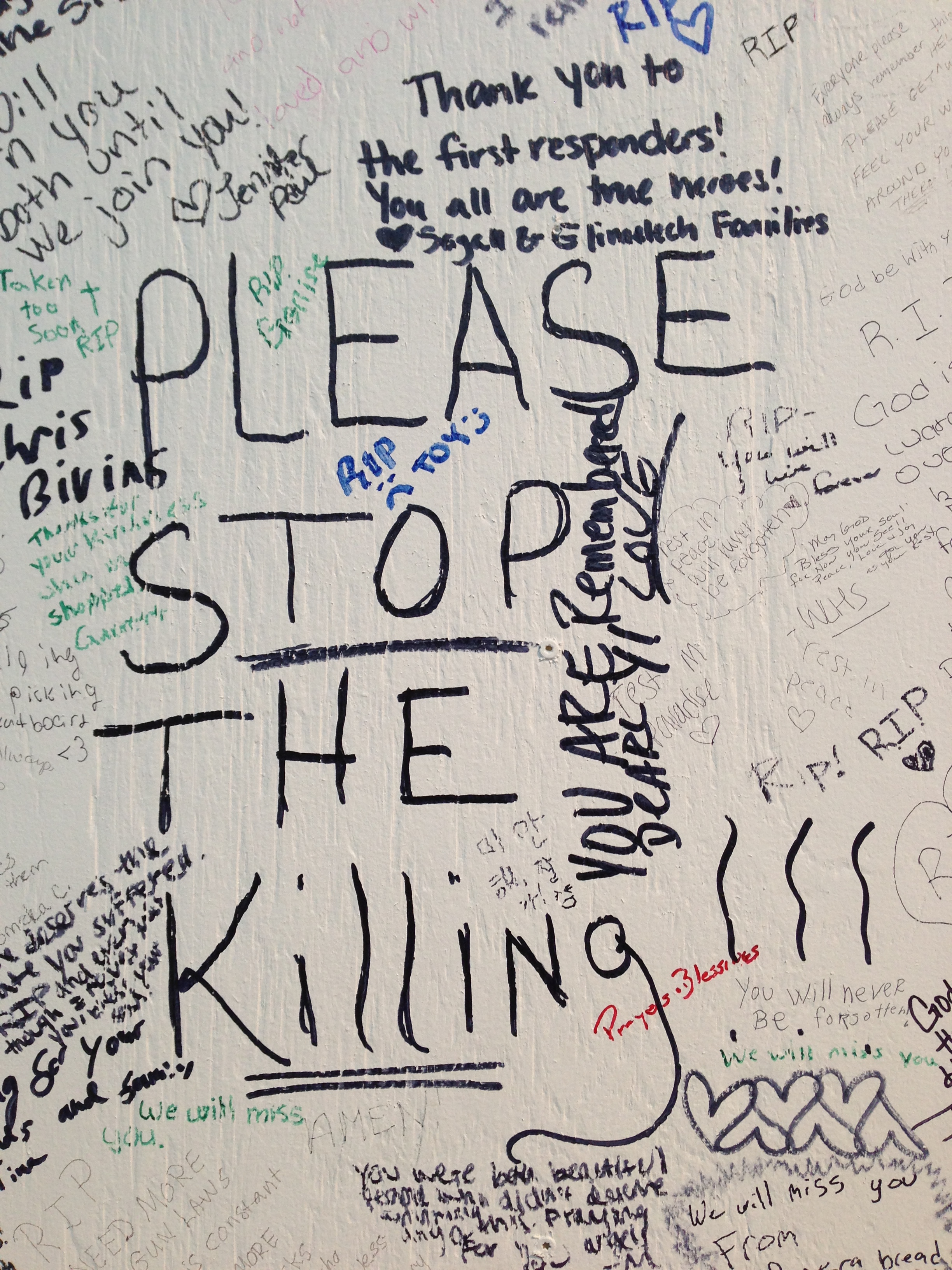
These photos were taken of an impromptu memorial at the Zumiez store where the events on January 25 occurred.


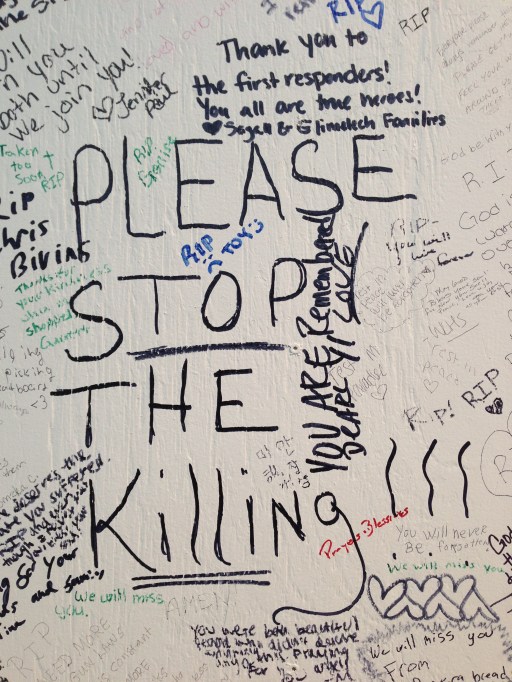
Brianna Benlolo, Tyler Johnson, and Darion Aguilar: I pray that your souls may find peace and that your loved ones may find solace as they survive your loss.


 And Another Thing, Hon