A Friday Morning PSA

To all my friends:

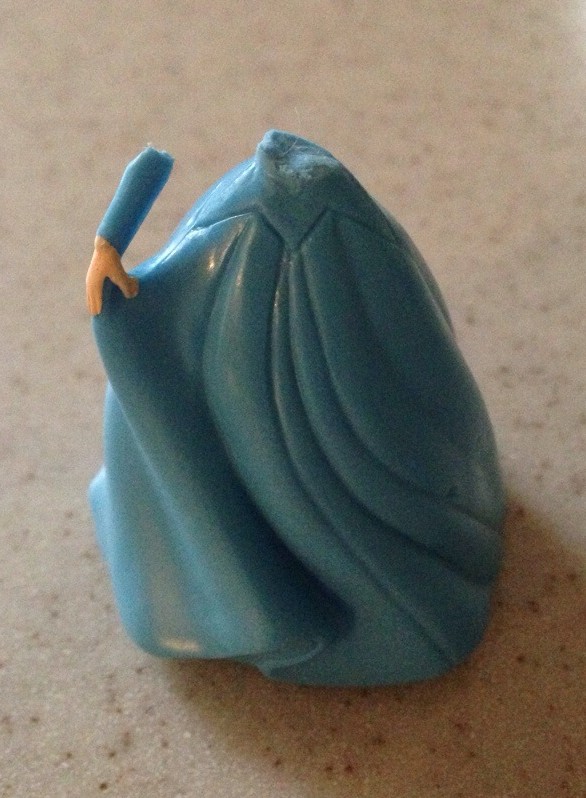
Photographed below is the remnant of what used to be a plastic Cinderella figurine.

A dream is a wish your heart makes...

A dream is a wish your heart makes…

Notice how, as a result of her impossibly tiny waist in comparison to the rest of her body, the cumulative effect of activity has resulted in her snapping in half and losing her torso/head.

Let this be a lesson to all women: we really should eat that chocolate.

Good Friday: A Broken Hallelujah

The first time I ever heard Jeff Buckley perform Leonard Cohen’s Hallelujah, it became the song that runs through my head whenever I think of Good Friday. I know it’s not an intentionally Christian song, but music, like all art, is open to interpretation. And when I hear Jeff Buckley telling us so beautifully that “love is not a victory march, it’s a cold and it’s a broken hallelujah”  I envision the passion of Christ.

I grew up in the Catholic Church, so I have been witness to imagery of Jesus’s infamous last walk and his subsequent crucifixion from my earliest childhood. I went to a Catholic college, where I studied medieval and renaissance art as part of our core requirements. And I have traveled to many very old churches and cathedrals in places like Spain and Portugal and France. I have seen some pretty gory Jesus pictures, and when I think of the Jesus of Good Friday, it’s not Happy Anglo Jesus that I see.

Not this Jesus.

Not this Jesus.

creepy jesus

Definitely not this Jesus.

It’s a beaten and broken Jesus that comes to mind, with a rope around his neck, bowed down under the weight of the cross  that will torture and kill him.  It’s not a pretty, or a comfortable image.

But it is an image of love. Whether you see Jesus as God, man, myth, or some combination thereof, the story of Good Friday is the same: it is the story of a good man who chooses to be vilified, shamed, beaten, tortured, and killed because he believes that in doing so, he is saving his people. That is love, and for me, Leonard Cohen describes this kind of love — what I think is real love — the best.

Because love isn’t a victory march. We like to think it is. We like to think it’s a feeling, and a triumphant and beautiful one at that. We like to see it as a power that overtakes us, and pulls us powerlessly but beatifically along its course. We like to think that love is something that exists in and of itself. It isn’t.

Love is a choice. When it is at its most powerful, love is raw and deliberate and difficult. It doesn’t have to be as dramatic as Jesus dying on the cross for the sins of his people. It can be as simple as a mother watching her child walk into kindergarten, even though her every instinct is urging her to hold that baby in her arms and never let go. It can be as mundane as a middle aged married couple mucking through the routine of their daily lives together, not because of romantic magic but because they chose one another and know that they belong together. And it can be as heartbreaking as a family holding the hands of a dying loved one, telling him that it is okay for him to let go, that they will survive without him, even though they can’t imagine how.

That first day of kindergarten is really hard!

That first day of kindergarten is a tough one.

I’m not trying to say that there isn’t joy in love — there is. That is where the hallelujah comes in. Because when we love, when we willingly let go of part of ourselves on behalf of someone else, we are unleashing the most glorious power in the universe.

I know that sounds like hyperbole. I am prone to exaggeration. But this time, I mean it. Because really, what else has kept the human race going through all messiness we have created? We have emerged from absolute horror time and time again, because there have always been people who have chosen love, time and time again. And for me, there is no greater symbol of this than the Jesus we see on Good Friday.

Love isn’t a victory march. It is a cold and broken hallelujah. And whenever I think of what happened today in my Church’s tradition, I know why I continue to believe. Easter may be the foundation of our theology, but Good Friday is the essence of what it means to be a Christian — and a human.

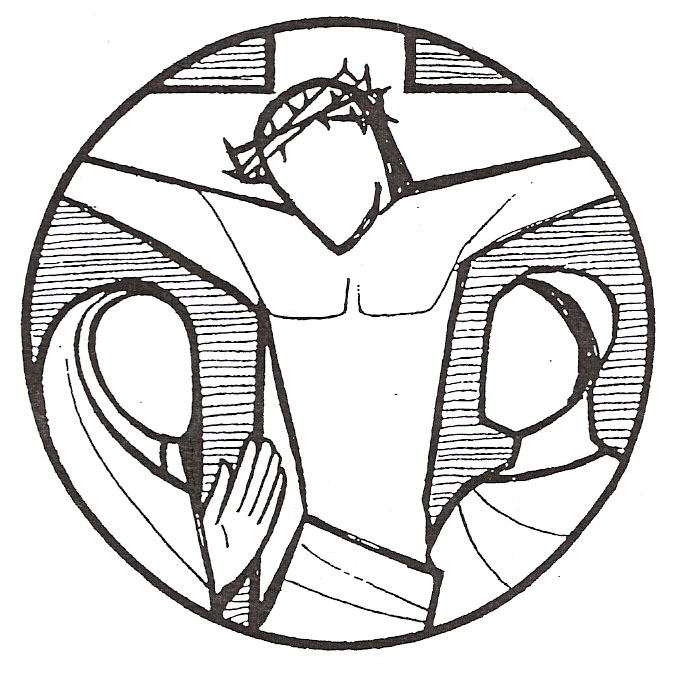
CrossLineDrawing

 * * *

And on a side note, you have to be a pretty talented composer to create a song that can remind a person (at least this person) of both Shrek and Jesus.

Flaunting Failure: My Messy Beautiful

Like most people, I don’t really enjoy bragging about my failures. I recognize them, and feel what is probably an excessive amount of guilt for having them (I’m not Catholic for nothing), but I prefer to keep them on the down low. They are not my favorite topic of conversation.

So it was as astounding to me as it would be to anyone else when, a few weeks ago, I found myself emphatically, almost eagerly, telling my daughter that I make bad choices and really big mistakes every single day of my life.

“Mommy is, like, a huge failure, sweetie!” I told her brightly. “I mean, I told Daddy to shut up this morning! That was really bad! And I yelled at the dog because he ate grass and puked on the new carpet, and then I yelled at Daddy again because I had to clean it up! And I forgot to pack your lunch that one time — remember?! I forgot it and I didn’t bring it until lunchtime was almost over and when I got there, you were crying in the cafeteria line? That was a really bad choice that mommy made.”

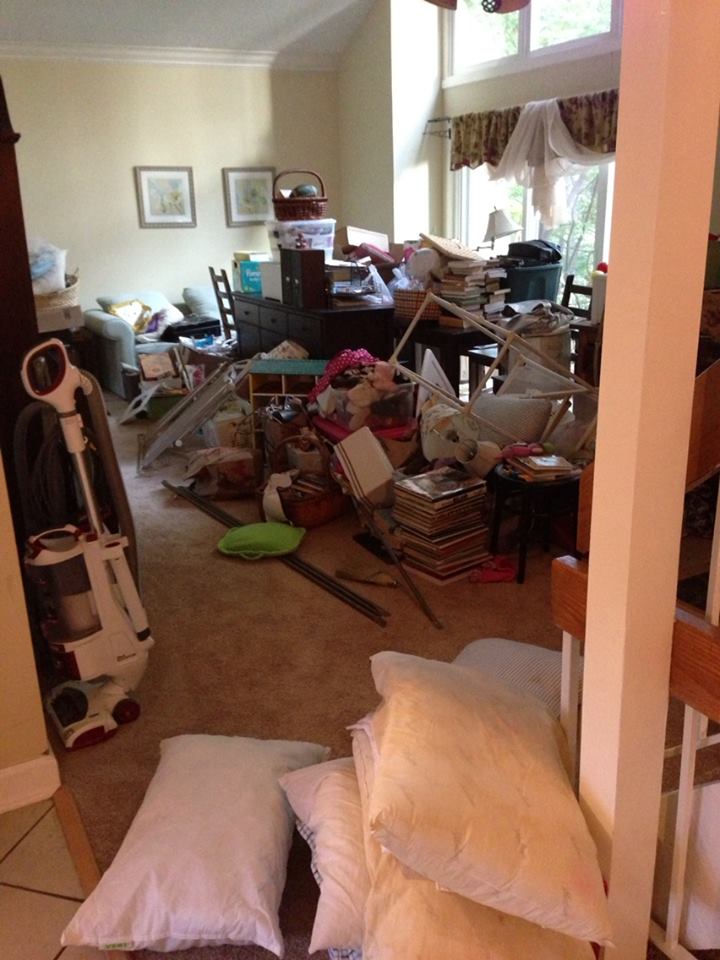
There was that time when my house looked like this.

There was that time when my house looked like this.

I stopped there, because the flow of my thought process was moving toward previous boyfriends and hangovers and tattoos obtained in foreign countries, and that whole lunch incident really was blemish enough on our mother-daughter relationship. We have plenty of time for all of mommy’s more spectacular failures to make themselves known.

This overflow of honesty might have been excessive, but it was not without purpose. Because it was in response to my baby girl sitting in the bathtub sobbing, wailing that she “wanted to be good ALL DAY and not just SOME of the day because you, Mommy, ALWAYS make good choices and NEVER make bad choices.”

How else could I answer her? I don’t always make good choices. I do make really big mistakes. I am never, ever perfect ALL DAY.

My daughter is on the Autism Spectrum. For the most part, her differences manifest as odd but charming quirks. However, there are times when the world becomes too much for her.  She has a certain rigidity to her expectations from life, and when life doesn’t conform to those expectations, she becomes overwhelmed. When she becomes overwhelmed, she becomes defiant and angry. And when she becomes defiant and angry, she begins to feel guilty, which leads to more defiance and anger until it all comes crashing down and she is empty but also somehow devastated by what she sees as her failure to be good.

That’s a lot of feeling for a five-year-old.

My heart breaks for her when she starts to fall down the Autism rabbit hole, and when I found her crying in the bathtub that night it was shattering to see that, this time, she was tumbling down because she was comparing herself — negatively! — to me. And it made me think.

I don’t like to broadcast my mistakes to the world at large, and I really don’t like to broadcast my mistakes to my children. As parents, we feel compelled to serve as an example of the kind of people we want our children to become. We want to be their heroes. And I think a lot of times, we strive to hide our faults from our children in order to meet the expectations we set for ourselves.

But the thing is, I don’t want, or expect,  my children to be perfect, or even almost perfect. And I don’t want them to grow up to become the kind of person who feels that perfection is expected from her. I want my girls to try new things, to succeed sometimes and to fail sometimes. I want them to know how to own up to their mistakes and to try to make things right. I want them to be able to forgive themselves for not being what it is impossible to be. Above all, I want them to know that they are both messy and beautiful, and wholly — overwhelmingly — loved. And they will never learn any of those things if I don’t teach them.

* * *

I have written before about losing my mother at a young age. It was hard to lose her. It is still hard to not have her. These things are true for anyone who has lost a parent. But one of the things that makes losing a parent when you are young especially difficult is the fact that you never get to know her.  She is always as she was to you when you were a child: perfection, and everything.

My mom would have been a hard act to follow, no matter what. One summer, she spent 6-hour days at the pool with a portable chemo pump delivering toxins directly into her bloodstream so my brother and I could enjoy our summer. She once fell and broke her neck in the morning one day, and that evening she showed up, neck brace and all, at a fashion show where I was modeling First Communion dresses. I have to bite my tongue on the F-word when I stub a toe, but breast-turned-bone cancer never even elicited a “damn my life” from my mother.

As far as I can remember, my mom was as close to perfection as a person can be. She never had the chance to prove otherwise.  I have spent much of my life feeling as though I will never, ever measure up to her — and now that I am a mother, I know that’s not what she wanted for me. It isn’t what I want for my own children.

* * *

So many of my parenting decisions have been made based on my desire to have the mother-daughter relationship with my girls that cancer stole from me and my own mother. Mostly, these decisions have had to do with being together — just existing in the world with them —  as they go through life’s big and small moments.

But behind all that is also my desire to be real for them. For us to grow together as a family, and to know that we love each other always, unconditionally.

And that night with my daughter, when her world was crashing down around her because she wasn’t good all day long, reminded me that sometimes, showing your children your failures also means that you are teaching them how to love themselves and others.

* * *

 This essay and I are part of the Messy, Beautiful Warrior Project — To learn more and join us, CLICK HERE! And to learn about the New York Times Bestselling Memoir Carry On Warrior: The Power of Embracing Your Messy, Beautiful Life, just released in paperback, CLICK HERE!

messy-beautiful-700b


A Country Western Kind of Day

Today has been a country-western song kind of day, but the stay-at-home mom version. It goes a little somethin’ like this:

“It’s Friday night and I’m home alone with my kids. They’re havin’ a screaming contest in the bathroom. (I’m hidin’ in the closet.)

I stepped on my brand-new glasses and I broke ’em. Super glued my fingers together when I tried to fix ’em. (I lost some skin on that one boys.)

I went to the store for eggs and milk. I forgot the milk. (And now the kids are cryin’)

I let the dog out and he ate some grass. It came back up and now it’s all over my carpet. (I’m savin’ that mess for my ole man! Ain’t that right, ladies?!) ”

That’s it. I know, it’s a work in progress. And I never said it would be a good country-western song. I didn’t even say that it would be a not-horrible country-western song. All I’m saying, is that as I was going through my litany of woes in my head tonight, they  were accompanied by a banjo and they came to me in a Toby Keith kind of voice. And yes, my inner thoughts are frequently voiced by celebrities with musical scores in the background. Aren’t yours?

On that note, let me finish my masterpiece with the following photo series:

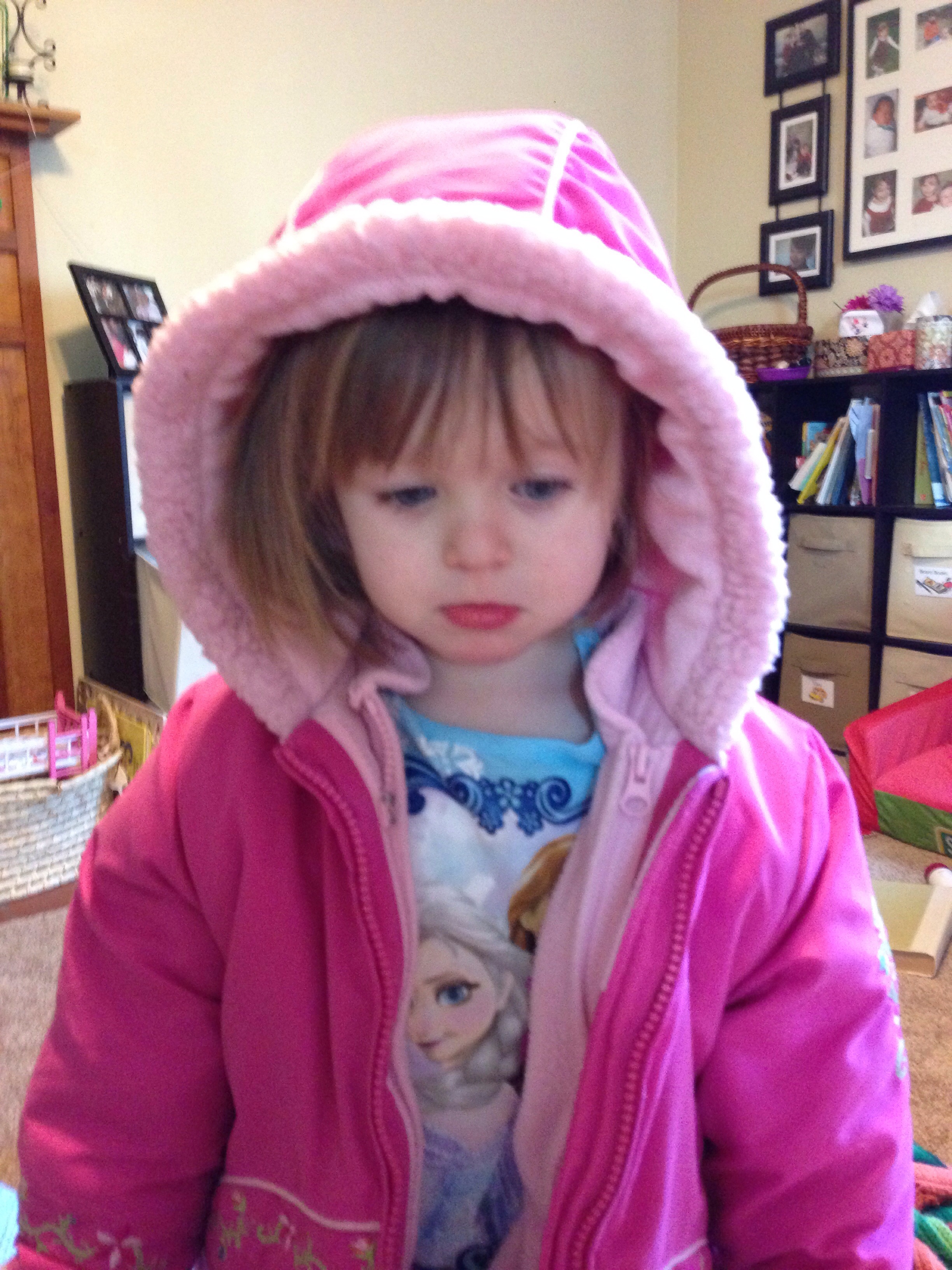
I put a coat on my girl, and she pouted.

I put a coat on my girl, and she pouted.

She took it off and laughed in my face!

She took it off and laughed in my face!


I strapped her in her car seat and won the battle.

I strapped her in her car seat and won the battle.

And now it’s bedtime! TGIF, Folks!

My Italian Leprechaun

The whirring and humming and thump-thump-thumping of a sewing machine will always remind me of one person: my dearly loved, and deeply missed, Italian-with-an-Irish-name grandmother.

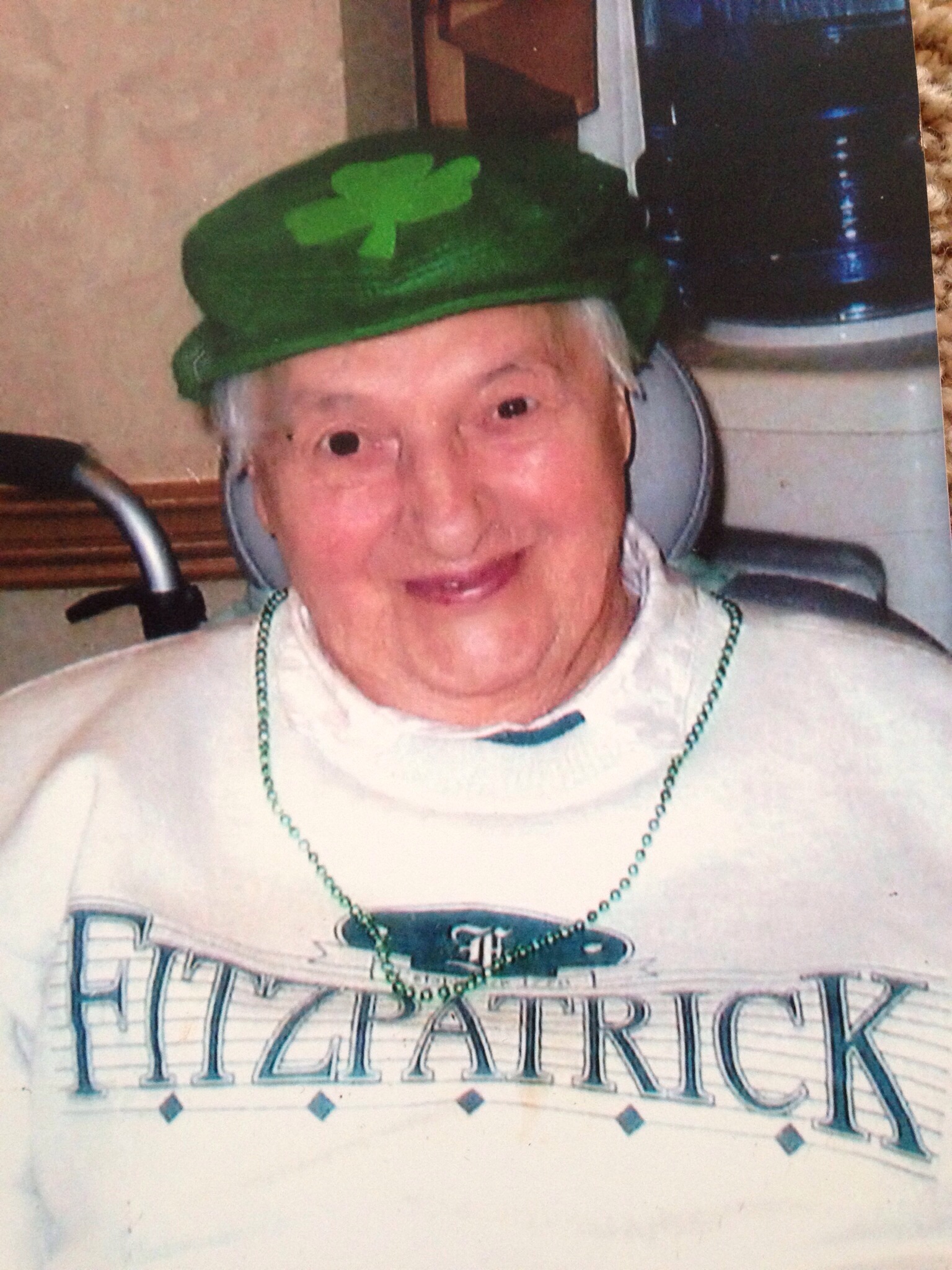
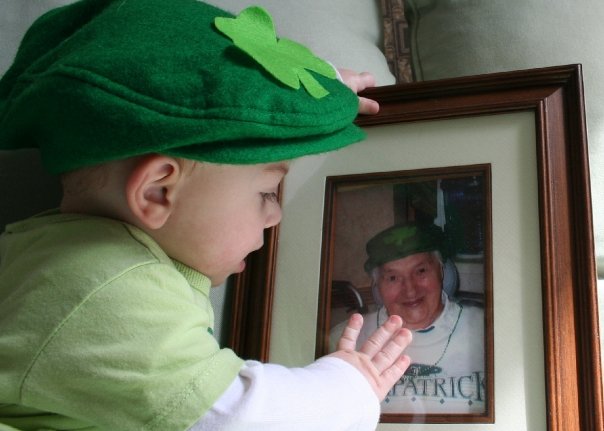
This lady:

If you knew her, you loved her.

If you knew her, you loved her.

Even though it’s been over 20 years since I sat in my grandparents’ family room watching Dukes of Hazard while my grandmother sewed, the sound of a sewing machine still brings her presence back to me. I spent so many hours in that room with her, especially during the long years of my mother’s illness, that I think I will always associate the sound of sewing with my grandmother, no matter how many decades separate me from my memories of her.

I have been thinking about this, and her, frequently over the past week, as I struggled to make a matching set of St. Patrick’s Day dresses for my daughters. After one failed (and un-saveable) attempt and many, many mistakes, I finally succeeded in creating two decently cute dresses that actually fit the child each dress was intended for. A minor miracle, in my opinion.

A St. Paddy's Day Miracle!

A St. Paddy’s Day Miracle!

I’d like to think that she would be proud of my effort, but I know better. I’m pretty sure my technique (or rather my lack thereof) would have driven her crazy, had she been there to witness it. I’m not very good at sewing.

Still, she loved St. Patrick’s Day, so I know she would have entered into the spirit of things, and she would have emphatically approved of the final product once she saw how adorable they looked on her great-granddaughters.

The other one ran away from the camera. -- but this one is pretty darn cute!

The other one ran away from the camera. — but this one is pretty darn cute!

For an Italian lady, she really did get a kick out of St. Patrick’s Day, even though her attitude toward the Irish was ambivalent at best during the rest of the year. She was born a Mastromonica, and she was proud of her Italian heritage. But she married an Irishman deliberately, because she refused to marry an Italian one: Her father used to make her mother, his subordinate, walk behind him in public. My grandmother was determined to walk right next to whatever man she married.

Still, it didn’t stop her from telling us, after her diabetes got so bad she couldn’t use her legs, that she was Irish from the waist down and Italian from the waist up. Her mind was spry, her legs not so much. She may have spent 60-odd years as a Fitzpatrick, but her heart pumped Italian blood.

But on St. Patrick’s Day, she was all Irish. She had her sweatshirt emblazoned with the Fitzpatrick name, and her green pants, which she paired with a jaunty felt shamrock hat and green beads. She wore that outfit every St. Patrick’s Day for years. And every year, with her short, round stature, her sprightly smile, and her twinkling, mischievous eyes, she looked just like a leprechaun. A laughing, Italian leprechaun.

Happy St. Paddy’s Day to you and yours, and as the old blessing goes:

May the road rise up to meet you.
May the wind be always at your back.
May the sun shine warm upon your face;
the rains fall soft upon your fields and until we meet again,
may God hold you in the palm of His hand.

My little leprechaun, on her first St. Paddy's Day.

My little leprechaun, on her first St. Paddy’s Day.

Hi, I’m Krista. I Break Minds.

One night last week, during our most recent spate of winter storms and school closures, my five-year-old told me that I was “cracking her heart into pieces” so badly that “even her mind was breaking.”

I earned this opprobrium when I responded to her request for paint so she could make “an angel with brown skin, a white dress, and beautiful gold hair” by saying, “No. Seriously. No. Go watch TV.” She was crestfallen —  heartbroken —  her mind had been shattered. If ever there were a pathetic creature, it was my child that night. I was unmoved.

I am heartless, I know. But before you judge me, wait for the context.

First of all, I was eating dinner. There is a beast that lives within me, and when she gets hungry, we feed her. My husband learned this lesson very early in our relationship. My kids seem to face a much steeper learning curve, or maybe they just don’t care about the consequences of interrupting a hungry beast at feeding time. Whatever the case may be, they think it is totally appropriate to do stuff like try to kill each other, or pee on the couch, or ask for art supplies while I am eating.

Secondly, it’s been a long winter of snow days. And most of them haven’t been the fun, “you wanna build a snowman” kind of snow day. Many were so bitterly cold that my thin-blooded girls were crying after 5 minutes of being outside. Then there was the storm that dropped so much snow on us that their short little legs couldn’t navigate through it. And even on the snow days when they could play outside, the outdoor fun never lasted more than 2 hours.

It was deep.

I’m not kidding, it really was deep.

We just don't get snow like this in Maryland!

We just don’t get snow like this in my part of the world!

The rest of the time, we were inside — crafting.

We drew, we glued, we painted, we cut (oh, the paper we cut!), we stamped, we beaded. We marker-ed our markers dry and the Lorax wept for all the paper we used. We mixed media, and we built things, and we littered our kitchen with art supplies.

I cleaned green paint off of brushes, clothing, fingers, faces, and furniture. I negotiated peace after an epic battle over glitter glue. I have peeled countless stickers off of every accessible surface of our home and I am still finding them in random places, like on the side of the toilet bowl and in my shoes. So after a winter of making stuff, when a snowstorm in March kept my girls home from school for two additional days, I felt no guilt over breaking my baby girl’s mind by denying her evening request for paint.

I didn't think we'd make a dent in these. We did.

I didn’t think we’d make a dent in these. We did.

People tell me that the girls will remember these days and the time we spent together fondly. I’m sure they will. My daughter seems to have recovered the use of her mind, without any permanent damage to its faculties. Certainly, her gift for hyperbole hasn’t suffered. She will be ok.

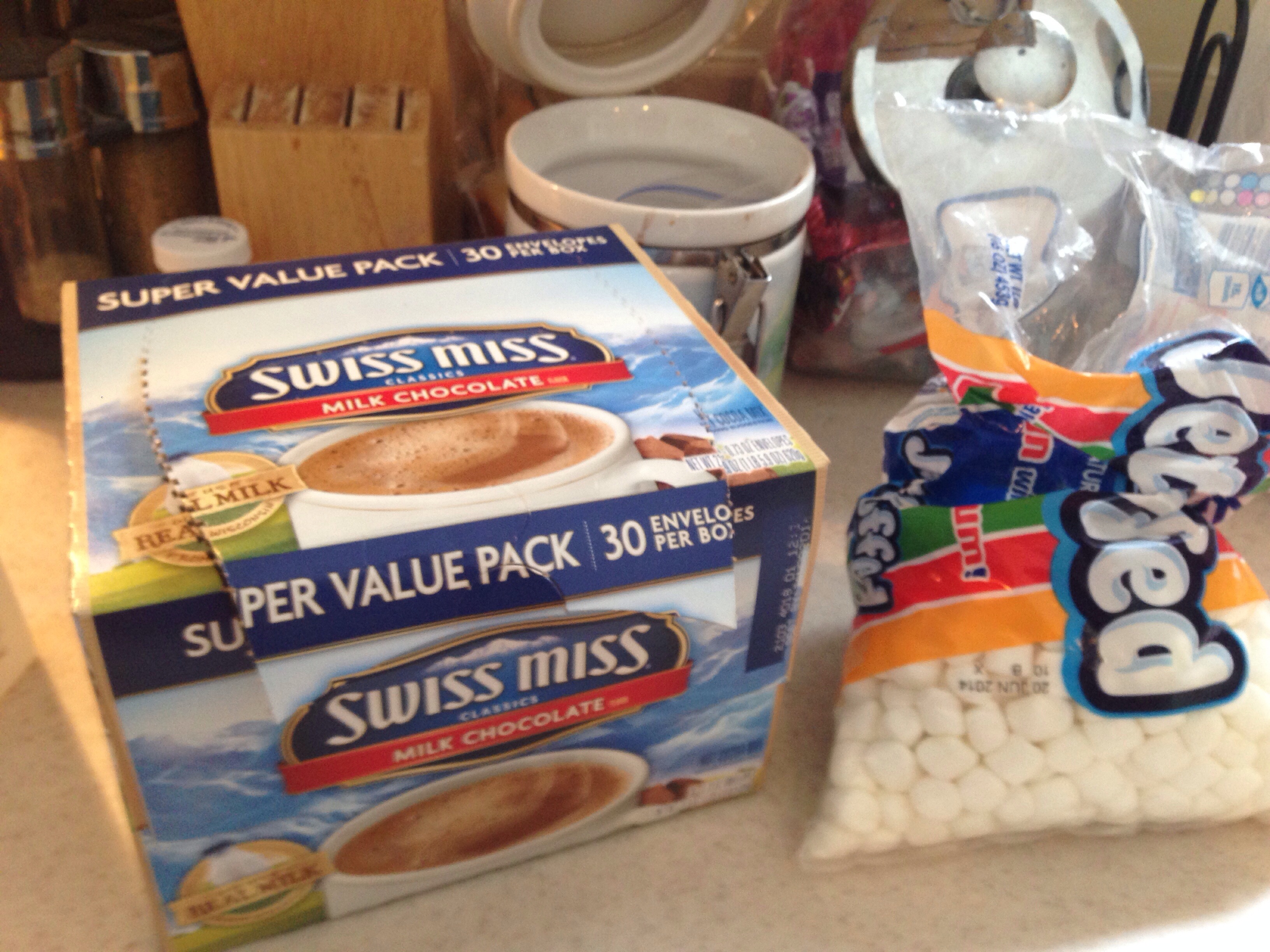
Meanwhile, it is March 13 and currently 30 degrees outside, with the “feels like” temperature at 21 degrees. A fierce and bitter wind is blowing. I just read a headline suggesting the possibility for snow on St. Patrick’s Day. And in my cabinet, I have a Ziplock bag, and in that bag are shamrock shapes and stickers, and green glitter glue, and a rainbow paint set, all just waiting for little fingers to craft with them.

Hi, my name is Krista, and my mind is breaking.

They Love Us Too

Last week, a dear friend of mine shared a beautiful tribute to her father, who passed away several months after her wedding, shortly after she became pregnant with her first child. She wrote:

“Today, on what would have been my dad’s 74th birthday, I remember the song I picked for the father/daughter dance at my wedding: Forever Young, by Bob Dylan.  I shared the song with my dad a couple of months before the wedding, and when he heard it for the first time, he teared up.  He understood why I chose it – not only is it a wish from him for me, but also from me for him.  We practiced dancing a little bit that day in my parents’ living room, and looking back I’m so very happy that we did.  By the time the wedding day rolled around, cancer radiation treatment had left my dad unable to stand without support.  Dad and I didn’t get to dance at my wedding, and a little part of me is sad when I think about that, but more so I am grateful that he was able to be there at all.
So, Dad, this one’s for you. 

I thought her post was profoundly touching, and not just because I knew her father — who was a good, kind, immensely intelligent man — or because I know how it feels to regret what you could not do with a beloved parent who has been beaten down by cancer.

What moved me the most was what she said about the song she chose for her father/daughter wedding dance — that the words of Forever Young were not just a wish from him to her, but also from her to him.

Bob Dylan’s Forever Young is a song whose lyrics can bring even the most unsentimental parent to tears. The first stanza alone has everything you need to feel both heart-swellingly hopeful about your child’s future and crushingly nostalgic about the childhood she will inevitably leave behind:

May God bless and keep you always.
May your wishes all come true.
May you always do for others,
And let others do for you.
May you build a ladder to the stars,
And climb on every rung. May you stay forever young.

Of course these are the things every parent wants for her children.  We want them to follow their dreams, and to be righteous and brave. We want them to be loved, and to know truth, and to find joy. We want them to be young, forever. We want them to have everything in the world that is good.

But my friend took this point further and reminded me that these are the same things our children want for us, their parents.

I have written before that the best thing we can do for our children is to be there, beside them, as they walk through life. But it is also important, for us and for them, to remember that —  behind the tantrums and the defiance and the smug know-it-all-ism of their early years — they both want and need their parents to be content and fulfilled. They want us to be strong, and healthy, and as young as they remember us to be. They want good things for us, too.

Our children, particularly when they are young, don’t often show us that our welfare matters to them. I’m pretty sure that if you asked my three-year-old, she would say that her greatest hope for me is that I forever provide her with goldfish crackers. Or that I forget the word “nap.”  My five-year-old would like me to concede with prejudice that I am not, in fact, the boss of her. I feel certain they would neither acknowledge nor express any lofty aspirations for me. But I think our children feel a need for our happiness nevertheless.

* * *

For the last few months, I have been battling one rough winter illness after another. I had antibiotic resistant strep throat for four weeks back in December, which led me to discover some minor, though temporarily worrisome, heart problems. Then in January, I picked up the norovirus at Chuck E. Cheese, which knocked me out for eight solid days. I am currently winding up another course of antibiotics for a sinus/ear infection and bronchitis. It hasn’t been an easy winter, and I haven’t been my usual self.

While all this was going on, I noticed that my five-year-old’s behavior at home had been getting increasingly worse. She was being contrary, oppositional, and having massive meltdowns at the least provocation. I was overwhelmed, and I couldn’t figure out why she had picked the time when I was at my weakest to bring out her worst behavior.

But eventually it dawned on me. She was reacting to my illnesses. It was because I was at my weakest that her behavior was it its worst. I wasn’t well and she was worried about me. I wouldn’t have argued if she had shown her concern in a less challenging way, but that’s how my girl rolls — when life pushes her over her limits, she pushes right back at life.

* * *

Our kids love us and need us to be there for them. They also want, and need, for us to be well and happy*. Our wellbeing affects them — but it also matters to them. They can’t find their own contentment if we haven’t found ours.

And if we do our job right, one day, our children will want everything for us that we want for them. That is a big and beautiful thought, and I am so thankful to my friend for reminding me that the love and concern we parents feel for our children is reciprocated, and powerfully so.

This one’s for you, CHW. And yes, Dad, this is my way of saying I love you, too.

From the Forever Young Book, by Bob Dylan and Paul Rogers

From the Forever Young Book, by Bob Dylan and Paul Rogers

*Read more about our right to be well and happy at These Walls Blog, by my friend Julie.

Religious “Liberties”

Today I went to pick up some tacos for dinner. When I got home, I saw that they had given me flour tortillas instead of corn tortillas. Normally this wouldn’t cause a sane person to find herself on the verge of a meltdown. But I have Celiac disease and I can’t eat flour tortillas. I also can’t eat the stuff inside of the tortilla, or anything else that was within touching distance of the tortilla. So no taco, beans, and rice platter for me tonight.

Instead, I popped some gluten-free chicken nuggets into the oven and logged on to read the news while I waited for them to cook. I was feeling pretty flammable to start with, so it’s not surprising that when I read this article about the Arizona legislation that “would allow business owners, as long as they assert their religious beliefs, to deny service to gay and lesbian customers,” I started to feel a rant coming on.

Things are changing in the 21st century, and there is an increasing number of issues in which the conflicts between secular demands and religious beliefs constitute a legitimate political debate. We are being forced to tackle contentious questions about how far our religious beliefs can go in dictating the way we implement laws, and how far those laws can go before they encroach on our freedom to practice our religion according to its particular theology. These are serious questions. But they have nothing to do with this piece of legislation coming out of Arizona.

I am going to go out on a limb and assume that the “religious beliefs” lawmakers are referring to are of the Christian variety. I have been a Christian since August of 1979 when I was baptized into the Catholic Church.  I went to Catholic schools from Kindergarten through graduate school, with the exception of the four years I spent in public high school.

I’ve learned a fair amount about the basics of what we believe, but I don’t know everything. Nevertheless,  there is one thing I can say with confidence: nowhere in our canon of beliefs does it say that we can’t sell stuff to gay people. There is no verse in the Bible that I am aware of in which Jesus or any of the major biblical players pronounce that “thou mayest not sell thy meatloaf platter to a man who lieth with another man.”

Seeking to establish legislation that couches discrimination in terms of religious freedom is really just an attempt to assert the righteousness of a certain kind of intolerance. There is no doctrinal basis for refusing service to anyone for any reason. It is self-justification, pure and simple.

The only religious liberty that is relevant to this legislation are the liberties these lawmakers are taking with their faith — with my faith. And what they have shown us is that they are willing to commandeer a faith based on love and redemption and sacrifice it to the alter of their bigotry.

The World Belongs to Such as These

Last Sunday, my five-year-old and I had the opportunity to spend the afternoon together, just the two of us, at a local indoor pool. With a younger sibling at home and a full day at school, time spent one-on-one has been rare this year. I’ve missed her.

My girl has a prolific imagination and spends most of her unoccupied time making up or enacting stories. As she has been learning so many new things this year, I have had the gratifying pleasure to observe how she weaves the new facts and ideas percolating in her brain into her stories and play.

So when we packed up go to the pool, I was interested to see her stash three princess figurines, three plastic cupcakes and a baby doll into her toy bag. I never really know where she will go with things.

When we got to the swim center, she headed straight for the baby pool, where she began setting up a scene. First, she brought out the three princesses and lined them up along the side of the pool. She placed a plastic cupcake in front of each. Then she went to her bag and brought out her baby. She carefully cradled it in her arm and carried it into the pool.

And then she baptized that baby, in the name of the Father, and the Son, and the Holy Spirit, Amen, using water consecrated with chlorine and the contents of a half-dozen swim diapers.

When I asked her about it, she explained to me that she had learned about baptism in her religious education class that morning. She told me that baptism is how we become a part of God’s family. And because she loves her baby doll, she wants her to become a part of our family. Therefore, a baptism was clearly in order.

photo (8)

It was an achingly sweet moment, the kind that reminds parents that bringing their child into the world really was the best thing they have ever done. It made me proud of her. It also made me reflect on and appreciate the best thing children do for us — allowing us grown ups to witness the fertility of their minds and the largess of their imaginations.

Most of us recognize the story from the Gospel of Luke, when Jesus urges his disciples to bring the children to him, because “the kingdom of heaven belongs to such as these.” It is a story that tends to be linked to the idea that what is most valuable in children is their innocence and unworldliness. It seems to imply that children, in their dearth of experience, are better able to absorb the teachings of faith, and indeed of the world around them. I don’t believe that this is a strictly religious way of thinking. There is a common tendency to think of children as blank slates waiting to be written upon.

Children are certainly unworldly. There is necessarily an innocence to the way they approach their world. They have no basis of comparison. They have no prejudice. Their minds are open. They are open, but I don’t think they are waiting, passively, for us to shape them. 

If I have learned anything about children and the way they approach life, it is that they do so through constant questioning and experimenting. They are endlessly pushing the boundaries of their universe. And these attributes apply equally to the way they understand faith and the way they process new facts.

When I think of my daughter, who is at that perfectly ripe age when the concepts of faith and fact are just coming within her intellectual grasp, I see nothing passive about her approach to the world. All I see is activity – a dynamic, unrestrained pursuit for more knowledge, a constant pushing and stretching of the limits of her understanding.

I hear her asking why, and no matter how thorough an answer I give, I hear her asking why again. I see her acting out, and re-enacting, what she is learning so that, through interpretation and experience, it becomes a part of who she is.

When I think of the idea that “the kingdom of heaven belongs to such as these,” I don’t see it as a calling to submissiveness or innocence. I see it as a calling for us to approach faith — and reason — like children do – with flexibility, enthusiasm, ceaseless questioning, and a mind with ever-expanding boundaries. Those are the best things that children have to offer the world, and we adults should not forget that.

After my daughter finished her charming baptism by pool water, as I was thinking about the profundity of what her mind, and the minds of all children like her, will bring to our future, she reminded me of something else.

She tossed her baby to the side of the pool and, splashing, shouted, “Mommy, that boy FARTED! He made BUBBLES in the WATER!” While I blushed and suppressed my silent laughter, I reflected on the next best thing children have to offer the world: their uninhibited appreciation for bathroom humor.

Life is best lived with curiosity, questioning, a mind without boundaries, and the ability to laugh at our bodily functions.

A Tale in Eight Words

There is a legend about Ernest Hemingway, in which the author bets a group of his fellow writers that he can compose an entire short story in six words. No one believes him, so he ups the ante to $10 from everyone who says he can’t. And then he writes the following words on a napkin:

“For Sale: Baby shoes. Never worn.”

We can assume that Hemingway won his bet. In the context of the time period, these words — by this particular writer — require only a fragment of imagination to put together an emotionally charged story of hopeful anticipation, heartbreaking loss, and the moving forward of the human spirit. The words are simple; the tale they evoke is profound.

Over the past week, another simple sentence has been in my mind:

“A gunman opened fire in a crowded mall.” 

In just eight words, within the context of our own culture, we have another story that is chillingly complete. We don’t need any imagination at all to know that terror and violence followed. That people were hurt in body and in mind and lives were lost. That there were heroes there too, and that strangers helped one another to survive. 

Those eight words are enough to tell us that a community was changed, forever. And they have been in my mind because this time, it was my community that was changed. 

Ten days ago, a disturbed young man came to the Mall in Columbia, less than two miles from my own home. He carried with him a bag that contained a gun, ammunition, and crude explosive devices. He opened fire in one of the most crowded areas of the mall, during one of the busiest times of the week. He killed two people, and caused injury to several others, before shooting himself. And all of this happened in front of hundreds of people — children, teens, and adults — who were living out their daily lives in a location that could reasonably be considered safe.

It’s hard to express how surreal it is to see your own neighborhood on national news as the scene of what appears to be yet another mass shooting. It is surreal, but not entirely shocking — I’m realistic (and anxiety-ridden) enough to know that a gunman shooting in a crowd can happen anywhere. Part of me was waiting for something like this to happen somewhere close by. Our mall is the ideal location for this kind of violence. But way you feel when you actually witness a shooting event unfold in your own community — with the knowledge that your own friends and neighbors are among those caught in the fray — is inexplicable.

Compared to other similar shootings, we got lucky — “only” two lives were lost. From what I have read in the news, it seems like our shooter intended to kill more people, but for some reason we will never know, he chose to stop the madness and kill himself instead. I’d like to think that he saw the horror he had caused, and just couldn’t cause any more. I’d like to think — and I do — that he felt remorse.

In the aftermath of a tragedy like the one that happened here we are faced with a sea of questions that come crashing in like waves. The most insistent of these questions is also the most contentious: How do we stop this from happening again? I wish I could answer this. Or, perhaps more accurately, I wish that we as a society could come together to answer this question. Because I do have my own answers, and I feel strongly about them. But for every person who agrees with me, there is another person who passionately disagrees with me. And it feels like none of us wants to listen to anyone else, with the result that instead of stopping the hatred and violence, we are fueling it instead.

But there is another, much smaller question, that faces my own community. And this question is: Do the events of January 25, 2014 define who we are?

I think they do.

People often use the word “overcome” to describe struggling successfully through adversity. But I won’t. Because when I think of someone overcoming something,  I envision an obstacle being climbed and left behind. We overcome the bumps in the road that try to stop our progress: injuries, illnesses, setbacks in our careers.

We don’t overcome hardship: we toil through it, absorbing it as we go, until it becomes a part of us. We weather it and survive it. Survival sounds like a pathetic goal, but it isn’t. Surviving is the most powerful kind of living. And when we survive adversity, we can never leave that adversity behind — because as we were mucking through, we were shaping our spirit. We are changed, forever, and I would argue, for the better.

IMG_3722

My lovely little city is an idyllic place to live. Our schools are excellent. We have hundreds of miles of woodland pathways that are trailed by rivers and streams. From my own home, I can run to three different lakes, where I can see deer and blue heron and geese and ducks and tiny little turtles and frogs. In the summertime, there are musicians, and dance instructions, and family movies at the large lake behind the mall. There are free concerts at one of our several truly beautiful local parks. I chose to live here because I didn’t want to live anywhere else. I love my life here.

But we are now a lovely little city where a gunman opened fire in a crowded mall. Those eight words have changed us forever. A tragedy of this magnitude must leave its scar. The lives of two young people were taken from us; we can never be the same again.

We are changed forever in another way, too. Because the events of that day brought out a part of our community that we had never seen before — a part that was always there, but whose fine edges were etched deeper through survival.

We  now know that we are a community that comes together in a crisis. We know that we can trust our emergency system — from the dispatchers to the first responders to the crime scene investigators — to do its job and to do it well.

 Our police arrived within two minutes of the first call. Dispatchers calmly talked people through their fear and advised them on what to do to stay safe. Stories from those who were in the mall at the time of  the shooting show acts of heroism and compassion from everyone who was there. Shoppers helped and comforted one another. Mall employees almost universally jumped in to help bring people to safety. They provided shelter and shared their food and helped entertain the children.

And we were taking care of those of us who weren’t there too. Within minutes of the first 911 call to the mall, I received a message from a dispatcher friend telling me to stay away. Seconds later, a friend who was at the mall with her young daughter posted the same message on Facebook. And within a half an hour, I saw more posts, e-mails, and text messages from people checking in on me and others than I could count. I have never been more proud to be a part of any community than I was that day.

We could have heard a story about mass chaos, about patrons crushing each other to get to safety and employees abandoning their posts to barricade themselves in the offices or backrooms of their businesses. We could have heard about inefficiencies in our emergency system or inadequacy among the officers who responded. But that’s not what happened. People shone.

A tale can be told in eight simple words. Lives can be lost, hearts can be broken, and a community can be permanently changed. But  of course we know that there is more to the story, more than can ever be put into words. My community has lived this story, and we will continue to live this story for as long as people can remember it. We won’t overcome it, but we will survive it. We will shine even more brightly because of the scars.

I still don’t want to live anywhere else in the world.

* * *

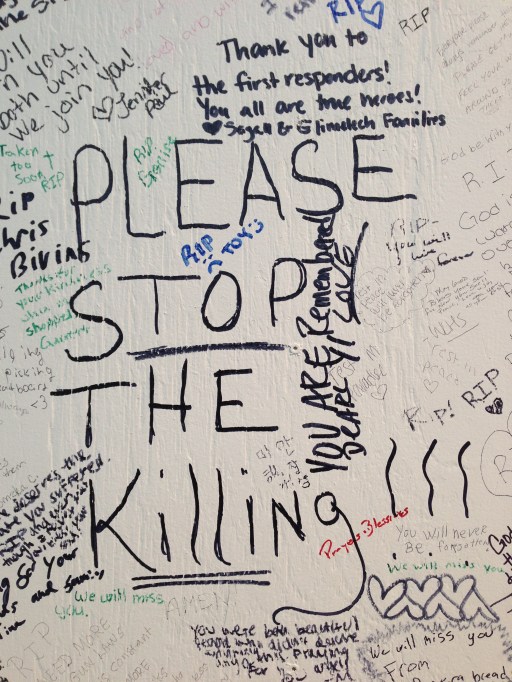
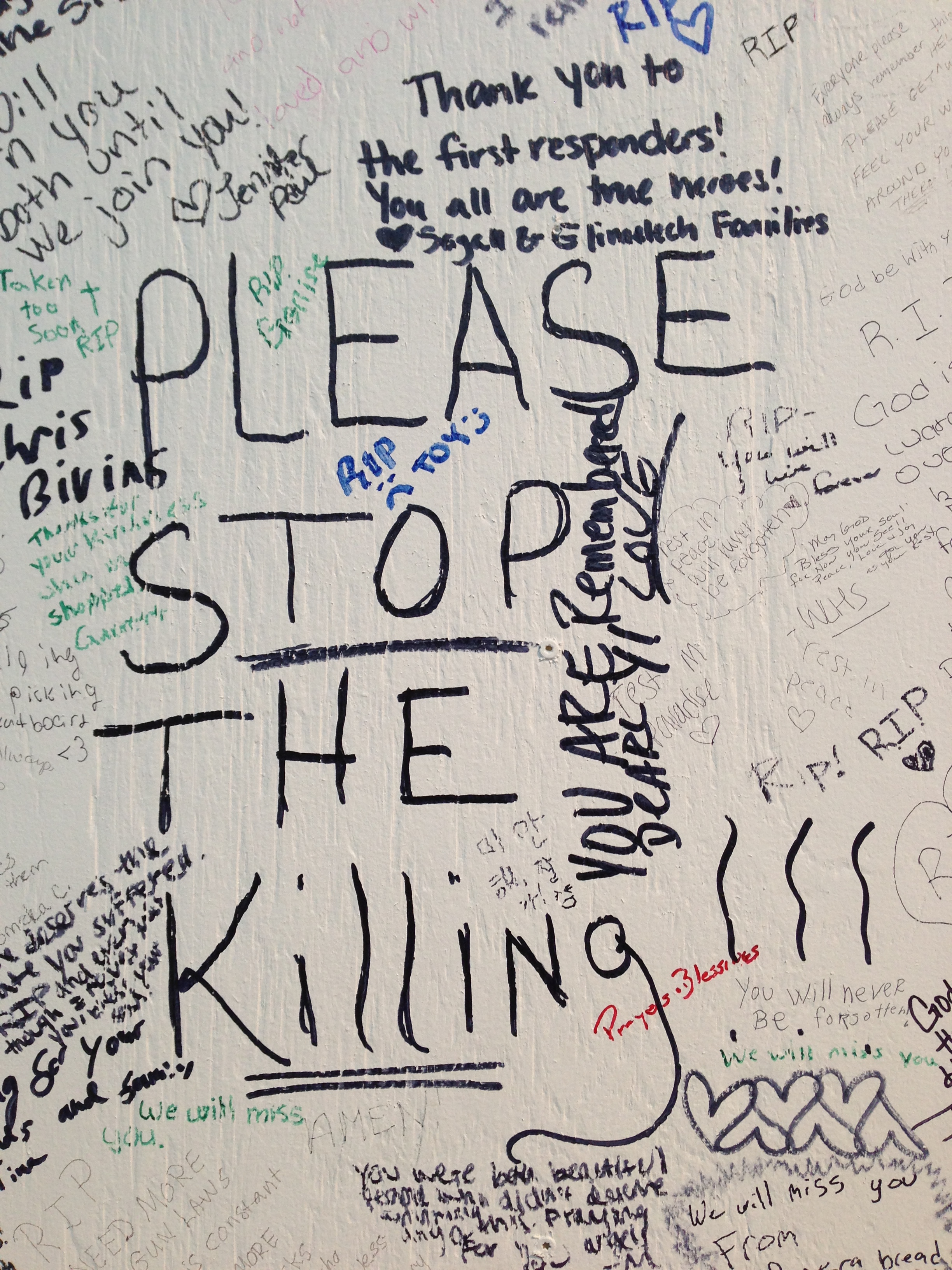
These photos were taken of an impromptu memorial at the Zumiez store where the events on January 25 occurred.

IMG_3713

IMG_3718

IMG_3714

Brianna Benlolo, Tyler Johnson, and Darion Aguilar: I pray that your souls may find peace and that your loved ones may find solace as they survive your loss.