How ‘Bout Them Apples?

appleI have lots of treasured memories about my paternal grandmother, but one that sticks with me the most is of her frequently saying, “how ’bout them apples?” I remember it having different meanings, dependent on whether the phrase was prefaced by “well” or “so.”

“Well, how ’bout them apples” was an expression of surprise — like, “Well, how ’bout them apples? Krista cleaned her room!” Alternately, “So, how ’bout them apples” was tacked on when she said something challenging, or something she knew my brother or I wouldn’t want to hear — like, “No you can’t have more crumb cake. So how ’bout them apples?”

She said it often enough that my little brother picked it up at a very young age and added it to his arsenal of phrases that he would pull out at the most inopportune moments. One time when we were at the mall, he saw an undressed mannequin, pointed to her breasts, and shouted, “How ’bout dem apples, grandma!” He was triumphant; I was humiliated.

“Dem apples” have been in the media a lot recently. They always are in the media, everywhere, relevant or not. But this week, they have been in the media for their actual purpose — feeding our children. Today is the last day of World Breastfeeding Week.

I wholly support the idea of advocating for better policies (for breastfeeding and just about everything else related to motherhood in America) and greater public acceptance of an act that is as natural as it is necessary.

But in addition to encouraging our (ironically) breastfeeding-phobic society to be a little more open-minded about mothers using their bodies to feed their babies, I would also like to see, in our community of mothers, a greater appreciation for the fact that, as mothers, it is our prerogative to decide how best to nourish our children. And, more importantly, to accept that other mothers, who might choose differently from ourselves, are doing the best they can for their babies — and for themselves.

Breastfeeding is hard. It’s hard when it doesn’t work the way you wanted it to, and it’s hard when it does work. I say this with the authority of someone who has experienced the extreme ends of the breastfeeding spectrum.

My older daughter absolutely refused to nurse. After a somewhat tumultuous pregnancy, she was induced at 37 weeks when it became clear that she was “failing to thrive” in utero. She weighed 5 lbs, 1.2 oz at birth and quickly dropped to 4 lbs 12 oz. Although she was healthy, getting calories into her little body was our primary concern. But she wanted nothing to do with me as a food source.

In the hospital, I tried everything. We used a syringe to squirt formula into her mouth while trying to get her to nurse in an attempt to pique her interest. Nothing. The lactation consultant hooked me up to a device that fed formula through a tiny tube taped to my chest, thinking that maybe if my daughter didn’t have to work so hard while nursing, she would take to it. She didn’t. They brought out other nursing aids and devices, all with the same result: complete refusal.

For six weeks, I tried to get my daughter to nurse. My husband and I came up with a tedious schedule, during which I would try to nurse her, with little success, then feed her pumped breast milk, then pump for the next bottle, again, and again, and again. It quickly became too much, both for me and for her.

I spent the next three months trying to convince my daughter to take my milk from a bottle. It was easier, but she was never an enthusiastic eater. She was, however, a devious eater. By the time she was four months old, she had developed the habit of drinking heartily from the bottle while letting a stream of milk pour out of one side of her mouth. That was the feather on this camel’s back — I had worked hard to make that miracle juice, and she was just spitting it all out. I just. Couldn’t. With that. Anymore.

Early on in this sojourn, I gave up reading books and articles from breastfeeding support groups, because the advice they gave always seemed to imply that women who struggled to breastfeed just weren’t trying hard enough. This implication was shattering. I already felt like a failure — as a mother and as a woman. Hell, I felt like a failure as a damn mammal — even mama pigs can nurse their young. I was exhausted, frustrated, overwhelmed, and valued myself as being on par with a crustacean. The idea that I should somehow have been doing more was the outside of enough.

These feelings of failure continued for about three years, until my second daughter was born. Unlike her big sister, that girl took to nursing like a cat to cream. She nursed enthusiastically, all day and all night. By the time she was eight months old, she was nursing every two hours during the day and every hour at night. That’s right – she woke up hourly. I slept in 20-minute increments. I was exhausted, frustrated, and overwhelmed – but at least this time I had elevated myself from bottom-dwelling sea creature to dairy cow.

My younger daughter is now two, and she has never taken a bottle. She also has not stopped nursing. And again, my choices in feeding my child make me susceptible to whispers of disapproval. Every time my walking, talking toddler latches on, in the back of my mind I replay every criticism I have ever heard – or made myself – of women who engage in extended breastfeeding. “It’s excessive.” “It’s unnecessary.” “It’s weird.” But whatever it is, it’s my choice, and I have made it thoughtfully.

Breastfeeding is hard. Not breastfeeding is hard. Being a mother is really, really hard. Your children are constantly challenging you, and society is constantly judging you.

But being a supportive friend to other mothers – those we know and those we don’t know – really isn’t that hard. Not when you think about how vitally important that support is, both to mothers and to the children they are raising.

So as we mothers remind our society that breasts actually are for babies and not just car commercials, let’s also remind ourselves that, when it comes to breastfeeding, an act that is so ageless and natural can also be stressful and heartbreaking. Let’s honor ourselves for the choices we have made, whatever they are, and let’s honor other mothers for the choices they have made, even if those choices are different from our own.

Our greatest strength is in each other. Let’s not forget that.

At The End of the Day

kung-fu-panda (1024x1019)

This guy was TOTALLY real!

Here is how you know you are tired:

Your husband says, “You know, Kung-Fu Panda was based on a real story.”

Then you say, “Really? I didn’t know that.”

Then he says, “Yeah, you never heard the classic underdog story about the fighting Panda with a duck for a father?”

And only then do you realize that he was joking.

We’re All Stories in the End

Last week, I had one of those experiences that all parents dread. I was sitting in the radiology room at an urgent care center holding my hacking, wheezing little girl in my arms, waiting for the technician to rig up the x-ray machine so my very petite child could reach it.

Our entrance to the clinic had been theatrical — I came in running, my daughter clinging to my neck and hips, as thunder boomed and shards of lightening sliced the horizon behind us. A massive storm was breaking.

When the x-rays were finally completed, they confirmed the doctor’s suspicion: my daughter had bronchitis and early stage pneumonia. It was our second day of vacation and things weren’t going quite as we had planned.

The following day, I was walking up and down the boardwalk leading to the beach with my two-year-old. She was naked but for a swim diaper because, for some reason, her swimsuit was oddly alluring to bees. In the span of just a few minutes, two bees had attached themselves to the fabric and settled in, almost as if drawn there by a force beyond their control. She panicked, so I yanked the suit to the ground and tossed it several feet away. The bees fled, but there was no way my baby was getting back in that suit without a fight. She revels in her nudity.

IMG_1127

Making the best of things

My five-year-old was wheezily building sandcastles because, despite her terrible cough, she was determined to fulfill all of her vacation plans. The little one — whom we had thought to be fearless — was terrified by the waves. So up and down the boardwalk we strolled, scuffing through the sand and noticing the little things, like bottle caps in sand dunes.I found myself thinking, with a laugh, “Well, in a few years, this will be ‘the vacation when Michele had pneumonia, and Norah was a Siren for bees, and I spent much of my time looking through the cracks of a boardwalk.'”

We did lots of other things — we saw dolphins swimming, we hiked in one of the most beautiful state parks on the East Coast, and, most importantly, we spent lots of time with my sister-in-law and her family, who live too far away for us to visit regularly. But those unexpected incidents were foremost in my mind.

Bees like balloon prints

Bees like balloon prints

It occurred to me then that the moments of our lives that we hold on to are most often those moments that came unplanned and were unwanted. Because those are the moments that we relive — and retell — over the years.

So much of life is in the telling — sharing our stories about the events that shape us. The good times are priceless in their own way; they bring us joy as they occur. But the challenging times, the unexpected incidents — the rainstorms, the lost luggage, the massively bad days — they make us reflect. They take us outside of ourselves and, in reliving those experiences, they open us up to a greater appreciation of the humor we can find in our own foibles and moments of distress.

We really are “all just stories in the end.*” It’s how we interpret those stories and how we share them with others that make them great.

 ***

“We’re all stories, in the end. Just make it a good one, eh? Because it was, you know, it was the best.” Dr. Who

*I’m only a budding Whovian, since I have just now started to watch the show, but I’d like to thank my friend Amanda at Bluestocking Rambles whose Facebook posts got me interested. My dad, too, since I remember the show from my childhood because of him.

Journey to Imagination

One of the best parts of parenthood is that it allows you to revisit the world of imagination, and to see it through the eyes of your children with the added perspective of adulthood. You realize, perhaps for the first time, how miraculous the imagination of a child really is.

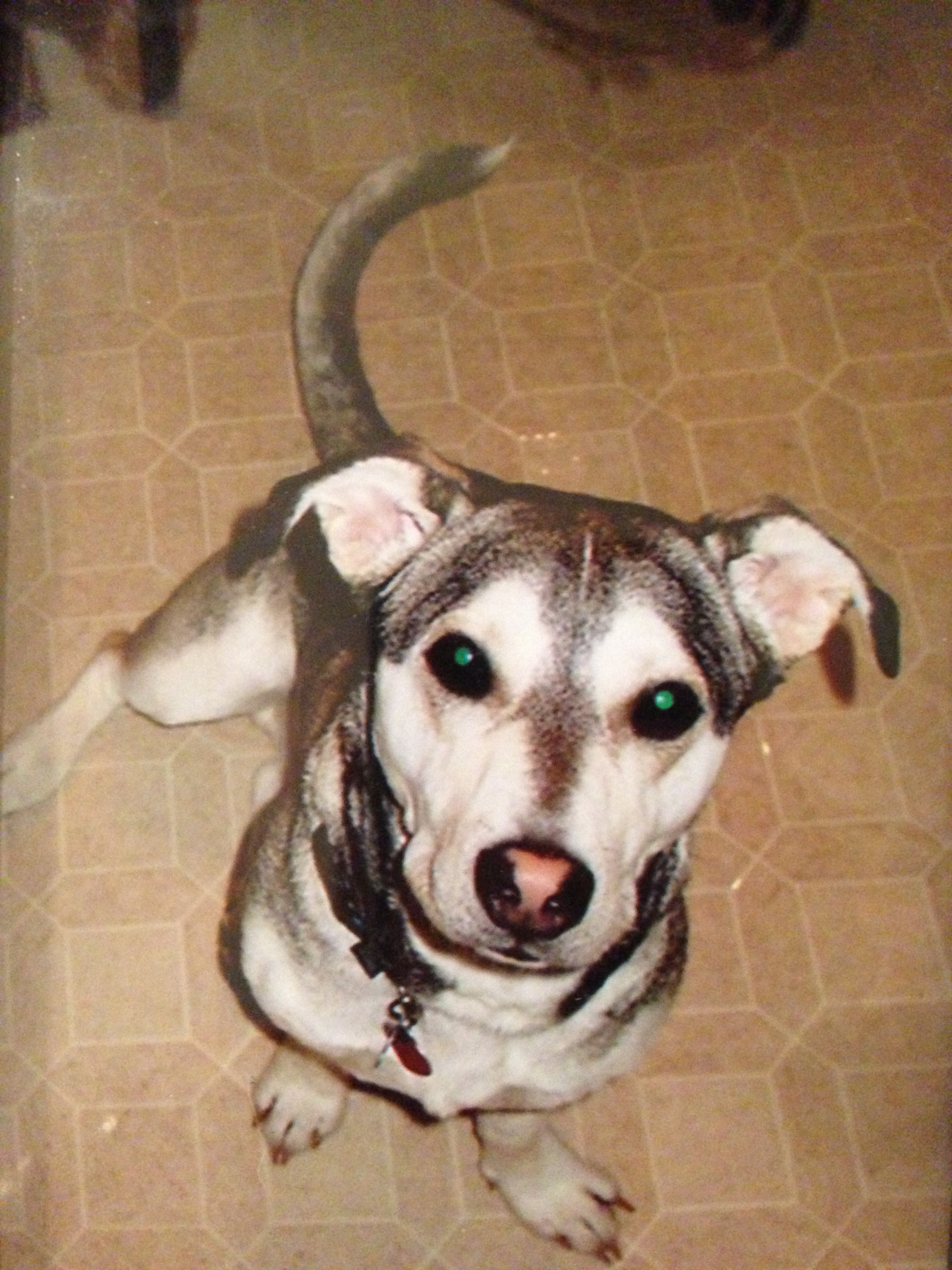
For example, our dog, Fred, often plays a vital role in my daughter’s games. Fred is a former stray who was found wandering in the wilds of West Virginia. Fred is a mutt of dubious origin – he looks a little like a Husky and a little like a Basset Hound. He has beautiful black, gray, and white markings on a long, stumpy-legged body. In human terms, Fred would be the love child of Uma Thurman and Danny DeVito.

Image

He’s cute. He’s grumpy. He’s weird.

But this odd-looking, neurotic little animal has an important job. In my girls’ games, he plays the role of the unicorn. It doesn’t matter if he is curled up on the couch snoring, or if he is barking vociferously at the squirrels in our yard. He is there, and he is the majestic unicorn.

That’s right folks, this funny-looking mutt stars as the most mystical, most magical, most beautiful animal ever imagined.

And that is the miracle of imagination.

De Colores

When my older daughter was about two, I spent lots of time teaching her things. Like colors — I came up with engaging, educational games that were fun for both of us. And they worked — my brilliant little miracle learned her colors. I was pretty amazed by both of us, and I stuck that achievement on the front page of my mental brag book.

Shake a butt

Who needs pants?

Then came my second daughter. As with most younger children, she got a much more faded, jaded, tired version of me. And now that she is two, most of our one-on-one time involves me chasing her around the house with a diaper and a pair of pants while she screams “no mommy! No dipey! No pants! I be naked!” She is lucky if she gets a couple of half-hearted minutes with a depleted set of her big sister’s flash cards.

So you can imagine my delight when, while she was sitting in the ball pit at our mommy and me gymnastics class, she picked up an orange ball and said, “yook, mommy! Orange!”

It was a miracle! Somehow, I had managed to teach her colors without even trying. I was better at this parenting thing than I had thought.

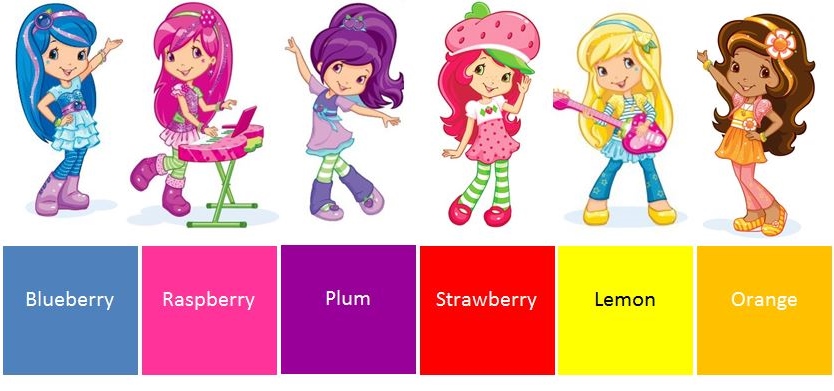
Then she picked up a blue ball and proudly exclaimed, “blueberry!” She not only knew her colors, but she was also associating them with fruit! The kid is a genius. I picked up a red ball and said, “Look! An apple! A red apple!”

“No, mommy,” she said. “No red. No apple. Strawberry.” Then she picked up a yellow ball and said, “And lemon. Dis one lemon.

And then it dawned on me. Orange. Blueberry. Strawberry. Lemon. She wasn’t talking about fruit, and she had only indirectly learned her colors. She was talking about characters from the television show Strawberry Shortcake. The new one, with characters that are much less child-like, and much more Barbie-like than the quaint version we moms grew up with. The one that she watches excessively, with the obsessiveness that only a two-year-old can attain.

I have achieved no miracle of parenting. My child officially watches too much TV. She still doesn’t acknowledge the words “red” or “yellow.” But do you know what she does do? Whenever she sees something purple, she says it is “plum.” She asks for her baby doll’s blueberry dress, and calls all shades of bright pink raspberry. This is what we call vocabulary building.

So next year when she is in preschool and her teachers are holding up that yellow card my child, the poetess of the class, will raise her little hand and declare that it is “lemon.”

And I will be proud.

Hey, it works.

Hey, it works.

Y por eso los grandes amores
De muchos colores me gustan a mí.
     Y por eso los grandes amores
De muchos colores me gustan a mí.

~ De Colores

Discovering You, Discovering Me

When I was younger I loved to color in coloring books. It was one of the few things I actually did carefully. I selected the colors I would use before I started. I traced the black outlines thickly, to ensure that I would stay within the lines. I shaded my pictures evenly, almost expertly, at least for a child working in Crayola. I was so particular that I would finish off each masterpiece by rubbing the crayon wax with a tissue until the colors were smooth and shiny. It was ART, and I took it seriously.

So when my older daughter was about 2 years old and she excitedly encountered her first coloring book in the dollar aisle of our local big box store, I was thrilled. I bought it with a new box of beautiful, unbroken crayons – one of my favorite things ever — and hurried home.

But things didn’t go the way I expected them to. My daughter’s initial excitement had been stoked by the full color pictures of Elmo featured on the front. The black and white interior was a letdown. Her interest was revived by the stickers she found inside, but it only took her about 30 seconds to plaster them on her arms and face before she was ready to move on.

At the time, I chalked it up to her age. Two is pretty young for artistic endeavors, after all. But three years have gone by and her interest in coloring books has remained pretty much the same, something that, for a long time, I found confusing.

Because this kid loves to draw. She loves to draw so much that a bucket of markers and a stack of computer paper have a permanent home on our kitchen table. Inspiration for a new picture can strike her at any time; one must be prepared. She draws at breakfast, lunch, and dinner. She often deserts her toys mid-game, struck with the idea for another picture.  She draws pictures of the stories she makes up throughout the day, and everything she draws, from people to raindrops, has a purpose or an explanation.

The fact that she is so artistic but yet is so little engaged by an artistic activity I always enjoyed mystified me. Until a few weeks ago, when she made the obvious answer clear to me.

She was sitting at the table, drawing as usual, when she stopped and said —

“Mommy, I’m drawing my world. Everyone has a world. This is mine.”

It hit me like a shove in the chest. Of course the kid doesn’t want to color someone else’s pictures in someone else’s book. She wants to make her own pictures, for her own book – for her own world.

***

The I Love You House

The I Love You House

It’s funny how much we parents want to see ourselves in our children. We yearn for that because when we see ourselves in them it signifies that we are as much a part of them as they are a part of us. And they are a part of us. They enter our hearts and our hearts can never part with them again.

But they don’t belong to us. And they aren’t us. When we think we see our quirks reflected in our child – we’re wrong. What we see is wholly, uniquely our child, a person who has never existed before and will never exist in another context ever again.

Looking for ourselves in our children is a mistake parents will probably always make. When you create something as miraculous as a human, and when your love for that creation is as deep as a parent’s love is for her child, it’s inescapable. It will cause conflict between ourselves and our children, just like it did between us and our own parents.

But it will be OK, just like it always has been, as long as we are listening when our children tell us that they are coloring their own pictures, for their own world.


And a woman who held a babe against her bosom said, “Speak to us of Children.”
And he said: Your children are not your children.
They are the sons and daughters of Life’s longing for itself.
They come through you but not from you,
And though they are with you, yet they belong not to you. ~ Khalil Gibran, On Children