When Speech Isn’t Free

In January, Mount Saint Mary’s University, a small Catholic college used to living a quiet life in the country, burst ingloriously onto the national media stage.

Student reporters for the University’s newspaper, the Mountain Echo, broke a story about a plan designed by school president Simon Newman to cull at-risk freshman, based on their responses to a legally-dubious questionnaire. I wrote about it as an alumna, along with dozens of other alumni and higher education reporters.

The story started out bad, and it has only gotten worse.

In the time since the Echo published its report, the newspaper was temporarily shut down. Its faculty adviser was fired — for no specified reason other than “disloyalty.” Another faculty member who contributed to criticisms against Newman’s plans was also fired for “disloyalty,” despite having tenure. An entirely new advisory staff for the student paper– approved, of course, by the president — was installed.

Faced with an untenable situation in which not only their academic freedoms, but their livelihoods, were threatened, faculty met and voted 87-3 to urge President Newman to resign.

Newman did not resign. He countered by reinstating the faculty he fired as an act of “mercy” — though the faculty themselves were not immediately informed what their “reinstatement” involves or even allowed access to their university email accounts.

He handed out doughnuts to the 70 or so students that showed up at a rally held to support him. He touted a student government survey that indicated a majority of its respondents believed in his mission, as if it were some sort of referendum. He vowed that he wasn’t going anywhere and he brought back the Mountain Echo.

It’s a version of the Echo, however, that reads like a state-sanctioned student newspaper out of North Korea.  Its return was announced with a list of letters to the editor, which were, as a whole, supportive of Newman’s approach. And its home page looks like a catalog of pro-Newman propaganda.

Looking at the newspaper from an objective point of view, you might actually believe that Newman really is, on the whole, embraced by the overall Mount community.

He’s not.

At least one other letter to the Echo editor was not published, despite being scheduled to go out in last week’s edition. The letter was critical of President Newman, but it served as a respectful request for him and the rest of the administration to listen to the voices of those who differ from them in opinion.

I know this letter was withheld because, with my fellow alumnus Nunzio D’Alessio, I wrote and submitted it. Clearly, our request to be heard was denied.

There are many stakeholders who have the best interest of Mt. St. Mary’s University at heart. Students, faculty, alumni, and the Catholic community of which the Mount has been a part for 200 years. We are not, by any means, universally supportive of President Newman or the Board that has consistently backed him up.

Alumni who criticize President Newman have been vilified by other alumni. We have been accused of trashing the school we (falsely) claim to love and damaging the Mount name. The bad press is our fault.

The student reporters who broke the story have been harassed and intimidated. Students who oppose President Newman are afraid to speak out. Some faculty will only use private email servers to discuss Newman because they are certain their emails are being read.

Today, FIRE (Foundation for Individual Rights in Education) announced its 10 worst colleges for free speech. Mount Saint Mary’s is at the top of the list. And until drastic changes to its leadership are made, that is where my school belongs.

From the first time I visited the campus, Mount Saint Mary’s has felt like home. What it is going through now is painful to see — it’s like watching a family fall apart. But I love the school enough to know that disloyalty isn’t speaking your dissent– it is staying silent when injustice and poor leadership threaten to destroy something sacred.

Krista Threefoot,
Class of 2001

Click here to support struggling freshmen at Mount Saint Mary’s.

The text of the letter that was not published in the Mountain Echo is below:

February 10, 2016

Dear Editor,

We, the undersigned, are alumni of this university who have for some time been concerned with the general direction and current state of affairs at our beloved alma mater.

While the precipitating cause of this letter is the recent debacle surrounding the so-called “retention program” (known among us as Bunnygate) and its support by President Newman and the Board of Trustees, we judge this most recent event as evidence of a much deeper problem.

Initial reports of President Newman’s retention plans were shocking. Even in hindsight, the program comes across as misguided. The language President Newman used to describe the culling of 20-25 “at-risk” freshmen, as bunnies to be drowned, was even more disturbing – it hints at a lack of respect for the constituents of the school and the faculty who were attempting to serve their students’ best interests.  

But, thanks to our Mount education, we are able to look past President Newman’s unfortunate choice of words to assess the issue on its own merits. It is in looking past his choice of words, however, that we find our source of concern.

Despite the explanations and justifications the administration has rushed to put forth, we still find little to reassure us that this retention program was intended to be as constructive and supportive as President Newman has recently described.

The Mountain Echo reporters have offered enough evidence to suggest that President Newman did indeed intend to encourage a set number of “at-risk” freshmen to leave the school by a certain date. The fact that this date would have enabled Mt. St. Mary’s to favorably manipulate their retention numbers is not, in our opinion, coincidental. Why would the faculty have refused to submit the data to the administration by that date if they had no concerns about how it would be used?

We are further distressed by the tone of Mr. Coyne’s Message from the Chairman of the Board of Trustees from January 22, and its attempt to cast doubt on the objectivity and methodology of the Echo reporters who broke the story. The Echo has been admirably transparent, providing more details than should be necessary on how they researched and verified information for the retention plan story. (See their Jan. 19 Editorial Note.)

We are alarmed by Mr. Coyne’s blatant attempt to discredit the students, alumni, and faculty who contributed to this story. Mr. Coyne’s letter appeared to suggest that any and all criticism of the President’s methods and motives is the propaganda of some sort of cabal of malcontents actively working against the best interests of the school.

This week, our concern has turned to outrage as we have learned that Mr. Coyne’s letter contained more than just vague accusations and idle threats. The demotion of Provost Rehm and the firings of Professor Egan and Doctor Naberhaus have been made public, along with a well-founded suspicion that their firings were the result of their opposition to President Newman’s agenda.

And it is here where we reach the heart of the matter we find most disturbing: Mount Saint Mary’s shines as a school in the liberal arts tradition where open discourse between people with differing ideas and opinions is welcomed and encouraged. The administration’s suppression of dialogue, its retaliation against those who speak out against it, and its unwillingness to address legitimate concerns about the direction of the school belies everything for which the Mount stands.

We write today cognizant of the many challenges currently facing the Mount as an institution of higher education. We are fully aware that the President and the Board are working hard to save a school facing serious – potentially catastrophic — financial difficulties. We recognize that these financial problems are President Newman’s inheritance, the result of his predecessor’s prodigious spending that increased the university’s debt substantially. We respect President Newman and the Board for their commitment to making the Mount flourish in a changing world.

But we worry that the administration’s unwillingness to engage in constructive dialogue with its critics is symptomatic of deeper problems besetting the University. Contestation and critique are vital aspects of a thriving liberal arts education. When the administration stifles the voices of those who question it, how can we trust them to preserve the Catholic liberal arts learning environment that has so profoundly enriched our lives?

We fear that in its push to make the Mount marketable, the administration is exchanging discovery, dissent, questioning, and critical thinking – the highest virtues of a liberal arts education — for an expanding quest for rankings, prestige, retention, and greater tuition and grant dollars.

Today, we address the Mount administration as academics, bloggers, nurses, therapists, educators, writers, television producers, scientists, journalists, business leaders, community leaders, mothers, and fathers. We are writing as the generation of alumni poised to lead society through the next decade, and we want you to know that the core, liberal arts curriculum and the vibrant spirit of community which characterized our Mount education are critical aspects of the unique contribution we are able to make in our world. The education we received at Mount Saint Mary’s 10, 15, 20 years ago is even more relevant now than it was then.

We ask that you respect our ideas, opinions, and concerns. We ask that rather than dismiss or discredit those in our Mount community who criticize your decisions, you respond openly and with transparency. We don’t want to be told what to think – our Mount education taught us to ask for more from life than directions to follow.

Our Mount education also taught us to speak out against injustice, whenever and wherever we see it.

We see injustice now, in the actions the administration has taken to punish those who refuse to toe the line. We ask that you understand that we will not stay silent.  

Above all, we ask that you work as hard as you can to preserve what we treasure most about our mountain home: its cohesive identity, rooted in the ever-curious, ever-seeking spirit of Catholic, liberal arts education. The future of Mount St. Mary’s University does, indeed, lie within the foundations of its past. On this point, we agree.

We sign with sincere gratitude for our Mount community,

Chinenye Adimora

Stacey Margaret Allen ’01

Adaora Azubike

Sarah Pilisz Babbs C’06

Jason Bacon ’01

Amanda Blizzard ’02

Meghan Bolden ‘04

Patrick Bolden, ‘78

Ken Buckler, ‘06

Toni Burkhard ’99

Martha Ciske – ’01

Lizette Chacon ’02

Eryn Chaney ’02

Joe Creamer ’01

Nunzio D’Alessio ’01

Krishawn Demby ’02

Christy V. Emmerich ’03

Reggie Eusebio ’00

Paul Evans ’03

Jen McAlice Fellows ’01

Michael Fellows

Steve Finley ’03

Angie Gilchrist ’04

Katie Reilly Giusti ’01

Kelley Wilson Griffin ’02

Melinda Hatcher ’01

Fran Harrington ’03

Cindy Stanek Holsworth ’02

Alison Zabrenski Humphreys ’01

Kevin Hunt ’00

Cuyler Jackson ’02

Kristen Johnson – ’02

Kelly Klinger ’02

Jen Mabe ’00

Katherine Stattel Mach ’01

Steve Manley ’02

Leroy Masser ’01

Gina Woods Mastromarino ’02

John W. Miller ’99

Mary Saynuk Monroe ’01

Kelly Wallin Morin ’01

Nola Occhipinti ’02

Ekene Adimora Ogwu ’01

Chloe Mathus Oram ’02

Elizabeth Polit ’01

Katie Sherman Rawson ’01, MBA ’07

Katie Hopkins Repetti ’01

Eric Seebach ’00

Jen Wieber Schildkraut ’02

Rebecca Walker Shoemacher ’03

Nicole Sinclair ’01

Erin McCartin Smigal ’01

Elaine Streck ’00

Krista Wujek Threefoot ’01

Sarah Tucker ’00

Beth Smith Utter ’01

Kate Vancavage ’02
Darlene Kukura Wallace ‘04

Julie Varner Walsh, ‘01

Kate Muldowney Watkins ’02

Matt Watkins ’02

Catey Heimerl Williams ’01

Wendy Brinig Williams ’02

Erin Callahan Woerner ’01

Rebecca Pagan Zamora ’01

Melissa Ismey Zimmerman ’02
An Angry Alumna

For graduates of a tiny liberal arts college that hardly anyone knows about, it’s always exciting to see your alma mater’s name in the international news.

Except, of course, when it’s in the news for doing something  you think is completely unethical – something even Donald Trump might consider shady – in complete defiance of everything the school has stood for over a span of 200 years.

Yesterday my news feed was flooded with stories of my beloved alma mater, Mt. St. Mary’s University and not one of them was good.

During the last decade, Mt. St. Mary’s has changed drastically from the school I knew. It is no longer a college, but a university. It has moved away from its intellectual, liberal arts focus toward a more business-minded emphasis. The school wanted more prestige and needed to make more money. And so things had to change. The leadership steered the school away from its traditional values into a realm more fitting for a corporation seeking to expand its profit margins.

Consider the news that came out of Mt. St. Mary’s yesterday. According to the school’s newspaper, The Mountain Echo, which was used as a resource for a later article published in the Washington Post, the newly appointed president of the university created a freshman questionnaire purportedly to “help students discover more about themselves”, which was to be used instead to cull students whose responses labeled them as being at-risk, with the goal of improving the school’s retention rates.

Higher education institutions are required to submit to the federal government the total number of students enrolled each semester. This number is then used to calculate the freshman retention rate, which is a factor that contributes to many students’ college selections. If a large chunk of a class’ population drops out after the first year, it could indicate something rotten in the state of Denmark.

Mt. St. Mary’s president Simon Newman had the bright idea that if the school got rid of students  who were destined to fail anyway ­before they had to calculate and submit their enrollment numbers, then the retention rate would be higher. Voila! And the best part – he’d actually be doing those students a service by saving them the wasted money of a semester’s tuition, room, and board.

When discussing this matter with faculty — who as a whole do  not support this plan —  President Newman urged them not to think of freshmen as “cuddly bunnies” with this charming metaphor:  “You just have to drown the bunnies … put a Glock to their heads.”

Because in a bunny-eat-bunny kind of world, you have to take out the runts before they get devoured.

Tough love has its merits, or so they say. I’m not very good at it myself.  But injustice is injustice, and that is what we are facing here. You can’t establish the certainty that a student will fail based on a survey he takes during freshman orientation. In fact, you can’t be certain a student will fail until they actually fail. You can’t treat a group of kids embarking on the educational journey that will shape their future like a herd of cattle being fattened for the market.

It’s disturbing to me that any group of leaders directing a university could think this way.

But what is worse, in my opinion, is that this decision came from a Catholic college that has always prided itself not only on its commitment to academic excellence but also on the strength of its community.

The community at the Mount is, or was, its greatest asset. When I was a student, we knew our professors personally. They took us out for beers and invited us into their homes. I babysat their kids. They treated us like equals, encouraging our curiosity and fostering our intellectual growth.

The community I was a part of helped freshman – and sophomores and juniors and seniors – who were struggling academically. They helped us when we were struggling personally. They invested in us. A small minority of students failed or left for other reasons, but at least they had a fair chance.

The community I was a part of was, in the most powerful sense of the word, a community. We had a shared identity that united us and defined us. And for me, having been part of that community continues to shape who I am today, nearly 15 years after my graduation.  The older I get, the more I realize how vital it is for me to be a part of something larger than myself. I used imagine that I would find my greatest fulfillment as a globe-trotting idealist, saving the world from itself.  Now, I know that my happiness is as deep as the roots I have formed. I have the Mount to thank for that.

The direction President Newman is taking Mt. St. Mary’s is the wrong one and his methods are unconscionable. It needs to be stopped. I’m hopeful that the negative media attention will force him and the board of trustees to change the course they has chosen. But in the meantime, it looks like it’s time for some strongly worded letters.

***

If, like me, you are a Mount graduate or a concerned member of the Baltimore Archdiocese (or if you just enjoy writing strongly worded letters) and you also feel the need to state your objection to the direction MSM is taking, here are some helpful links:

Contact information for the University cabinet: http://msmary.edu/presidents_office/university-cabinet/

Office of the Archbishop of Baltimore: http://www.archbalt.org/about-us/offices/archbishop-office/index.cfm Email: archbishop@archbalt.org

Baltimore Sun news tip contact: newstips@baltimoresun.com, 410-332-6100


What Grief Has Taught Me

what grief has taught me

It’s January 6th again, the day that I dread. I can hardly remember a time when I didn’t dread this day, and I think I will continue to dread it as long as my memory is intact. I’ve been dreading it more than usual this year, because January 6, 2016 is kind of a big deal.

Today marks the 25th anniversary of my mother’s death from breast cancer. I don’t know why this number seems so significant. There is something about a quarter of a century that feels substantial.

And I don’t know why measuring the time that has passed is so important to me. It’s something I just do, automatically. I can say with certainty, though, that these 25 years have changed me. Looking back to 1991 from 2016 feels like looking from one world to another. To me, it is a different world. I’ve grown up.

I’ve grown up, and I’ve grown in understanding. The roles that cancer and loss have played in my life have never been far from my mind. I’m a thinker (and an over-thinker), and I’ve never stopped thinking about the parts of my life that have so fundamentally shaped the person I’ve become.

So, small though my pool of knowledge might be, I do know this:

Cancer is a family disease.

I’ve never had cancer, but cancer is a part of me.

My mother was first diagnosed when I was four. I was young, but I was very aware of the fear gripping my family. I used to have this nightmare, over and over and over, so often that 32 years later I can still remember it in near-perfect detail. I was in my parents’ bedroom – pale blue walls, bed covered with a white, tufted chenille bedspread. My mother was standing at the foot of the bed packing a suitcase. My father was in the corner of the room crying. I was squeezed between the bed and the wall, watching, hidden. Behind my mother a bear hovered — it wanted to take her away. I knew my mother was scared but didn’t want to show it, and I knew that my father was crying because he was helpless.  This scene would repeat itself in a loop, and it scared me stiff.

Chronic illness — when it carries with it the potential of a death sentence — is terrifying for the person fighting it. It is also terrifying for those who love and need that person. During the long seven years of my mother’s illness, in my heart I was fighting alongside her. The time that has passed since her death has done nothing to diminish my sense of having battled and lost to cancer.

Sharing death with someone is an intimate, profoundly affecting act and everyone should do it once.

My mother died at Christmas. Technically, she died on the last day of Christmas, the Feast of the Epiphany. But really, her death began on the 26th when she fell into a coma that only broke when her pain became uncontrollable.

I was there the whole time. I was with her when she lost consciousness. I heard her when she emerged only to moan in pain. I learned what dying breaths sound like and I stood beside her as those breaths ebbed to a stop. I could almost see her soul depart her body.

Four years ago, when I was nearly 37 weeks pregnant with my second daughter, I sat in another room with another person I loved as cancer took his life away too. This time, it was my uncle – one of the best humans I’ve ever known – who was making his surrender. With my aunt and my cousins, I held his hand through a death that was not peaceful.

The memories of my mother and my uncle dying are among my most painful. But I also treasure them. There was an inexplicable beauty in those moments, a sense of connectedness and love. I’m better because of them.

Grief grows as one body.

When you first experience grief – not just great sadness, grief – it creates a sort of nerve in you with the cause of your grief at its core. And once that nerve exists within you, you can’t experience loss without it being touched.

Shortly after my mother died, my grandfather died, also of cancer. I grieved my grandfather, whom I loved deeply, but his death renewed my grief for my mother. As death took more of the people I loved, an uncle, my grandmothers, an uncle again, I grieved each individually and all of them together.

When my second uncle died four years ago, I felt the loss of everyone who had gone before him. But oddly enough, the grief I felt was also a kind of resurrection. Grieving them together somehow brought them back to me individually. For a time they were all with me again.

People die, but grief doesn’t.

Grief is a gut punch like no other. It shatters you absolutely. People tell you that it goes away with time, but it doesn’t.

And as much as you wish in the early days that it will go away, that it will release you and let you go back to being the person you were before it took over your life, you end up not wanting it to go away.

Time makes living with your grief more bearable, but it also takes you further away from the person you have lost. Eventually, grief becomes the strongest connection you have with them.

In 25 years, the world has changed. I’ve changed. And with every year that passes, it’s as though time has taken my mother further away from me. I don’t feel her presence anymore. The memories I have of her are pitifully few. I take them out like treasures now, cherishing them, guarding them, but lacking a sense of their relevance in my daily life.

And now that the grief of missing her in every moment has lessened, a new grief has taken its place – the grief of not missing her in every moment. It’s a quieter grief — and more bearable — but it’s grief all the same.

After 25 years, what I know above all things is that grief never dies.

Mom


What’s in a Flag?

I first started writing this post on June 20, shortly after the Charleston church shooting. At the time, I was feeling baffled and sad and, honestly, angry, even though I really had no right to be angry. It wasn’t my community that was targeted; my perspective is comes from the other side.

But I was angry, and my anger clouded my thoughts so much that expressing them would have led me to saying things I would later regret — mainly because my anger was for people with whom I identify, those who make up the social circle in which I live. My anger was for people who, like me, have had the privilege of living in skin that is accepted, respected, and protected but who cannot (or will not) accept that we do not live in a post-racist society.

Back in May, when the Freddie Gray story was all over the media, I was confused how, after so many deaths of young African American men at the hands of police and vigilantes, there could still be people in our country refusing to acknowledge even the possibility that racism exists in our country.

I asked myself then what it would take for the racism deniers to see what is staring them in the face — the fact that racism is a fact in our society, not a theory or a possibility or a shadow of the past.  And I thought to myself — these people aren’t going to see what is right in front of them until something horrific happens, like a lynching or the burning of a black church. You know, the kinds of things that used to happen back in the days before the civil rights movement, when racism was law.

And then, on Wednesday, June 17, a white man wearing emblems of white supremacy proudly on his clothing, entered a historic southern black church with a gun and killed nine black people.

***

After it happened, I found myself thinking that now we would have no more excuses.  Now there is nothing else we can use to cover the abscess that is racism in our country. A white man  killed nine black people in a church that is a sacred symbol of the civil rights movement in the south. The denial must end here.

Except that it didn’t end there. People continued to struggle to find an excuse, any excuse at all to explain the motivation behind this hate crime, as long as it wasn’t racism.

And when I say people, I don’t mean the gormless trolls who lurk in the bowels of comment sections. I mean political leaders. Governors and congressmen and presidential candidates — people we rightly view as representatives of a significant percentage of our society.

When I started writing this, in that context, I was baffled beyond the point of frustration and into the territory of fury.

* * *

In the weeks since the murders of Cynthia Marie Graham Hurd, Susie Jackson, Ethel Lee Lance, Depayne Middleton-Doctor, Clementa C. Pinckney , Tywanza Sanders, Daniel Simmons, Sharonda Coleman-Singleton, and Myra Thompson, the conversation has, finally, begun to change. Many of those who hesitated to label the killings as a hate crime against black Americans have backpedaled. Some have admitted they were wrong.  The most vehement deniers haven’t stopped denying, but their voices have, at least, been drowned out by a louder call for equality.

The amount of change necessary to answer this call for equality is staggering — it always has been, which is why, after each instance of brutality against black people that gains national attention, the demand for change becomes diluted simply by how immense the problem is.

But after these killings in Charleston, our call for change seems instead to have become distilled into a demand for the removal of the Confederate flag from our public spaces.

***

It’s a start. Certainly a flag that was raised in treasonous rebellion against the United States in order to defend and promote an economic system that forced one group of men to call anther group their masters has no place in any authentically American institution. It does not belong on the flagpole of a State House building. It doesn’t belong in a state flag, or as a representation of any level of American government.

The validity of this argument was finally recognized by a majority of lawmakers in South Carolina, the heart of the confederate flag debate, and at last the flag was removed from a space it had no business occupying. And it is coming down in dozens of other places across the country.

Again, it’s a start. It is good to see that the reasonableness of the argument against having a literally treasonous flag flying over a state capitol has been recognized by many who once denied it. And it is a reasonable argument. It’s not a radical, fringe idea to suggest that a flag used in battle against the American Government does not belong in our public spaces.  And it isn’t a radical idea to suggest that a flag which represented an army rebelling at least partly in defense of an economic system based on the enslavement of black people is racist.

No hate here.

#HeritageNotHate 

Yet we still don’t seem to have reached the point where, to believe otherwise —  that is, to believe that the confederate flag does have a legitimate place as a symbol of who we are in a pluralistic democracy based on the principle of the equality of all men – is also not a radical, fringe idea. We only have to look at the way our (black) president was greeted when he drove into Oklahoma City earlier this week. Welcoming him with the waving of confederate flags, people were quick to defend their actions as “not racist” but as a “celebration of their heritage.” (Arguments which are hard to believe when groups like the KKK, who openly identify as racist, rally under the mantle of that very same flag.) But beyond that, there is no separating the heritage of the South from the heritage of racism. The glory of the old South had its foundation in an economic system dependent upon the enslavement of black people. The history of our nation is imbued with the bloody stain of racism: we cannot bleach it out. But far too many of us continue to try.

NO HATE HERE... (Members of the Fraternal White Knights of the Ku Klux Klan at Nathan Bedford Forrest Birthday march July 11, 2009, Pulaski, Tenn.   SPENCER PLATT/GETTY IMAGES)

No hate here… (Members of the Fraternal White Knights of the Ku Klux Klan at Nathan Bedford Forrest Birthday march July 11, 2009, Pulaski, Tenn. SPENCER PLATT/GETTY IMAGES)

The confederate flag does have a place in America —  it belongs in museums, where we honor the history that has made us who we are today. The Civil War was by no means a war of pure good versus pure evil. There were heroes and virtue, villains and vice, and racism on both sides of the divide. The best way for us to understand the nuances of war is through our study of history — not through the veneration of a flag that represents to so many the greatest sin we have ever committed as a nation.

***

As I look back at this month of anger and hurt and social upheaval, I am still not at peace with the example being set by people who share my skin color and my privilege. In my continued frustration and disappointment, all I want to say is that these people do not represent me. Not me.  But perhaps what I should really be saying is, “I’m sorry.” Because I know that racism is alive and thriving. I know that the whiteness of my skin puts me at an automatic advantage. And I don’t know how to change it. And I am sorry.

Our Baltimore

About 18 months ago, I ran the Baltimore Half Marathon.

As I ran through the streets of the city of my birth, I noticed something — the sidewalks of nearly every street, in nearly every neighborhood, were overflowing with people cheering us on.

There were white people, brown people, black people — people of all the races and ethnicities that make up the beautiful, diverse, charming city of Baltimore.

They were out there together, supporting all us crazy fools out there running, together. These people — the obviously homeless man who raised his brown-bagged bottle to us, the couple in front of a gentrified townhome who handed runners cups of Natty Boh, the thousands of people whose voices we heard but whose faces we didn’t see — they got us through that race, as much so as all the months of training that preceded.

I’m seeing the streets of Baltimore again today. The whole world is seeing those streets today. And what we are seeing is not a city united. We are seeing a city that is broken and bleeding. We see a city out of control, hemorrhaging with hate, lost to violence in protest of violence.

I don’t know how to reconcile those images. It seems impossible. But then again, unity and brokenness are equal parts of Baltimore’s soul.

I can say this, though — rampant, pointless violence for the sake of violence has no place in the heart of this city.

And those images on TV today do not define the people of Baltimore. They don’t define who they are today and they don’t define who they will be tomorrow. The people of Baltimore are so much better than this.

I Understand, Robin Williams

This morning as I drove to the gym, I was listening to a radio DJ express how astounding it was to him that Robin Williams, a man who was so beloved, so successful, so loaded with talent, who had a genius that made millions upon millions of people laugh, could, underneath all of that, have dealt with a depression so powerful that it caused him to take his own life. I can understand how people would be baffled by that seeming incongruity. But this is the truth of depression: that it digs deep and it divides the soul and that in the depths of this divide is where it casts it shadows.

Depression isn’t unhappiness. And it is more than the kind of unhappiness that comes and goes without a definable cause, which is how so many people perceive depression. In the midst of depression, you can experience laughter, happiness and even true, overwhelming joy. You can be cheerful and outgoing and funny and charming. But in depression, you learn to be wary of the good feelings, because they never come alone.

In depression, a shadow self, one that is in you, of you, always around you, convinces you that in this great, wide, terrible, wonderful world, you’re really nothing. There are so many other people, everywhere, who are so much more valuable than you are. And although you know that you have worth in the eyes of the people who love you, you also know that really, you, in your essence, are worthless.

And in your worthlessness, the things that should make you happy — even the fact that they do make you happy — make you suffer because you don’t deserve them. You don’t deserve happiness or success or any of the good things that come your way.

And when your successes bring  you praise or accolades, you feel pride and exhilaration and a crushing conviction that you are a fraud.

And after awhile, when there is nothing on the surface of your life that isn’t shadowed by the ingrown knowledge that you are a worthless, undeserving fraud, you start to feel  despair, or you start to feel nothing, but whatever it is that you feel,  you have little hope that it will ever change.

And for some of us, a lifetime of despair, or a lifetime of nothingness, or a lifetime of vaulting between the two extremes without hope of escape becomes too much. It just becomes too much.

* * *

I’ve dealt with anxiety and depression for as long as I can remember. I am adopted, but the one thing I know about my paternal heritage is that depression and addiction run powerfully through that side of my family of origin. And I can already see signs of depression sprouting in my six-year-old daughter. I’m familiar with what depression can do to a person.

Depression is a lifelong companion. It can be a burden, but it can also be a gift. It forces you to be introspective, which is where creativity often is born. It also inspires you to be kind, because you know how precious and painful life can be.

Depression is also treatable. It can kill, but it doesn’t have to. The important thing to remember is that depression  hides, and it hides itself well. It’s a whirlpool under a placid surface. You encounter it often, but you rarely see it.

So be kind. Be tender. Remember that there are people to whom life seems meaningless, but who choose, every single day, to keep living because they know they have to — and because there is still a flicker of hope that lights their darkness. You can’t cure depression in someone else — but you could be the one who helps to keep that flame alive, so that person chooses another day.

Nanu Nanu, Mork.

Nanu Nanu, Mork. You lit up our lives with laughter.

* * *

For a funny and heartbreaking take on depression (because depressed people are actually pretty hilarious), visit Allie Brosh at Hyperbole and a Half and read her comics, Adventures in Depression and Depression, Part Two.

For resources on how to help yourself deal with depression, visit Jenny Lawson, The Bloggess, who is another awesomely funny writer who also suffers from chronic depression.

And, of course, NAMI has an exhaustive list of resources for people with depression and those of us who love people with depression.

How ‘Bout Them Apples?

Last week was World Breastfeeding Week, and I intended to re-blog this post from last year during that time because it expresses pretty much everything I have to say on the topic of breastfeeding. But, as my grandmother also used to say, I have a tendency to be a day late and a dollar short. I feel justified in posting this today, though, because my Facebook feed this morning showed me two completely different articles featuring photos of celebrities breastfeeding their babies. And the breastfeeding mommy wars that pit mothers who can and mothers who can’t and mothers who do and mothers who don’t against one another is an on-going thing.

Krista Threefoot's avatarAnd Another Thing, Hon

appleI have lots of treasured memories about my paternal grandmother, but one that sticks with me the most is of her frequently saying, “how ’bout them apples?” I remember it having different meanings, dependent on whether the phrase was prefaced by “well” or “so.”

“Well, how ’bout them apples” was an expression of surprise — like, “Well, how ’bout them apples? Krista cleaned her room!” Alternately, “So, how ’bout them apples” was tacked on when she said something challenging, or something she knew my brother or I wouldn’t want to hear — like, “No you can’t have more crumb cake. So how ’bout them apples?”

She said it often enough that my little brother picked it up at a very young age and added it to his arsenal of phrases that he would pull out at the most inopportune moments. One time when we were at the mall, he saw…

View original post 986 more words

Questions of Faith

Book2Last night, a neighbor of mine invited me to her house to participate in a group discussion led by author and activist Kelly Bean on her new book, “How to Be a Christian without Going to Church: The Unofficial Guide to Alternative Forms of Christian Community.”

Going into the event, I had no idea what to expect. I hadn’t read the book, and I was unsure of what I could contribute to the conversation.  But I was intrigued, because my neighbor happens to be a Christian pastor and the fact that she was hosting a discussion on a book that seemed, essentially, to serve as a guide for people who wish to leave the church without losing their faith excited my curiosity.

Also, the title of the book suggested an experiment in faith with results that were very different from my own personal experience. As I have said before on this blog, I am Catholic to my backbone. My Catholic identity is rooted in the deepest core of my soul, and I know this to be true because there were times in my life when I was disappointed enough in the Church that I tried tear it out of me. But as I explored other faith communities — and even tried for a time to live my faith without any institutional connections — I discovered that no matter what I did or where I went, I could not experience faith in any capacity without feeling the pull of its ties to my intrinsic Catholicism.

Kelly’s book is, essentially, the story of people who went through an experience similar to mine, but who ended up with a completely different spiritual result.

So I went to the gathering feeling curious and, as often happens when our minds are opened up to new thoughts, I came home feeling even more curious.  Because in discussing how people connect to a community of faith, our conversation touched on a topic that, I think, is of central importance to modern religion: the question of how we live our spirituality within the numerous layers of community that make up the fabric of our lives as individuals and, ultimately, as citizens of a broader world.

This is a question with many faces. Most basically, it asks people of faith, whether they are deeply connected to an established and structured religious organization or whether they are flying on their own wings, how they live their beliefs. Is our faith something internal, which provides us with hope or inspiration but which isn’t a part of our outward lives? Is it a ritual, or a routine, that shapes how we spend our time more than the person we are? Is it something we share with others by simply participating mutually in liturgy, or is it something that enables us to form powerful spiritual bonds with others?

But this question also forces us to consider what our spiritual life means in the more extensive context of our existence in this world. On the simplest level, does our faith make us better people? Does it empower us to live gently, in service to others? And more esoterically, how does it affect the way that we participate as citizens of our larger non-faith communities? In a heterogeneous world, how do our beliefs affect those who don’t share them? How do we know when the expression of our faith hurts others, and where do we draw the line between living our faith and living in a group in which there are those who feel that their freedoms are curtailed by our beliefs?

This may come as a shock, but I don’t have the answers to any of these questions. Many of them weren’t even formed in my mind until last night, and there are many more brewing beneath the surface. But I think reading Kelly’s book is a good way to start thinking about what is at the heart of our faith, what inspires us to celebrate it, and how we can be more aware of the way our faith communities affect both the individuals who comprise them and the greater world around them.

A Country Western Kind of Day

Today has been a country-western song kind of day, but the stay-at-home mom version. It goes a little somethin’ like this:

“It’s Friday night and I’m home alone with my kids. They’re havin’ a screaming contest in the bathroom. (I’m hidin’ in the closet.)

I stepped on my brand-new glasses and I broke ’em. Super glued my fingers together when I tried to fix ’em. (I lost some skin on that one boys.)

I went to the store for eggs and milk. I forgot the milk. (And now the kids are cryin’)

I let the dog out and he ate some grass. It came back up and now it’s all over my carpet. (I’m savin’ that mess for my ole man! Ain’t that right, ladies?!) ”

That’s it. I know, it’s a work in progress. And I never said it would be a good country-western song. I didn’t even say that it would be a not-horrible country-western song. All I’m saying, is that as I was going through my litany of woes in my head tonight, they  were accompanied by a banjo and they came to me in a Toby Keith kind of voice. And yes, my inner thoughts are frequently voiced by celebrities with musical scores in the background. Aren’t yours?

On that note, let me finish my masterpiece with the following photo series:

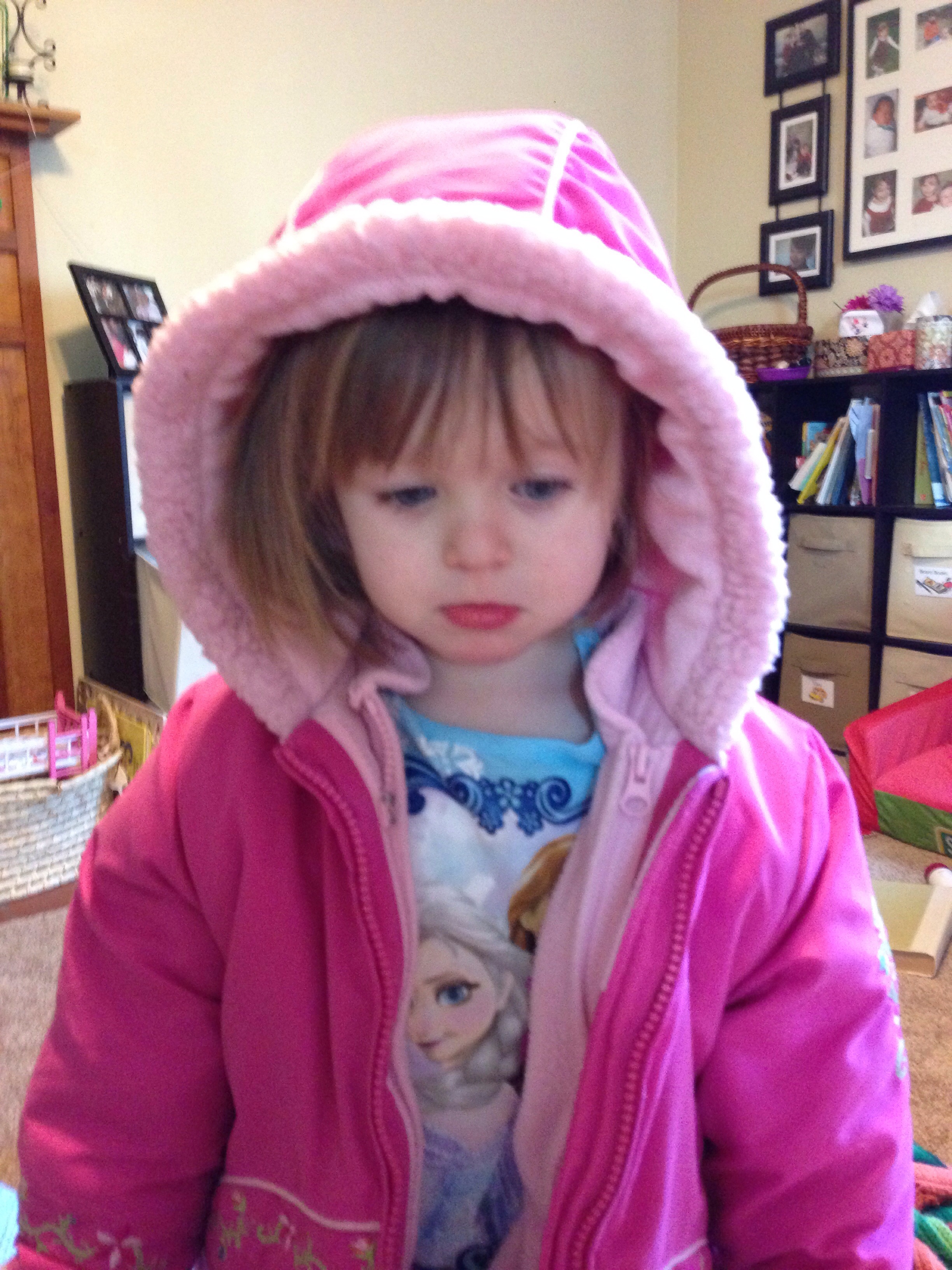
I put a coat on my girl, and she pouted.

I put a coat on my girl, and she pouted.

She took it off and laughed in my face!

She took it off and laughed in my face!


I strapped her in her car seat and won the battle.

I strapped her in her car seat and won the battle.

And now it’s bedtime! TGIF, Folks!

Hi, I’m Krista. I Break Minds.

One night last week, during our most recent spate of winter storms and school closures, my five-year-old told me that I was “cracking her heart into pieces” so badly that “even her mind was breaking.”

I earned this opprobrium when I responded to her request for paint so she could make “an angel with brown skin, a white dress, and beautiful gold hair” by saying, “No. Seriously. No. Go watch TV.” She was crestfallen —  heartbroken —  her mind had been shattered. If ever there were a pathetic creature, it was my child that night. I was unmoved.

I am heartless, I know. But before you judge me, wait for the context.

First of all, I was eating dinner. There is a beast that lives within me, and when she gets hungry, we feed her. My husband learned this lesson very early in our relationship. My kids seem to face a much steeper learning curve, or maybe they just don’t care about the consequences of interrupting a hungry beast at feeding time. Whatever the case may be, they think it is totally appropriate to do stuff like try to kill each other, or pee on the couch, or ask for art supplies while I am eating.

Secondly, it’s been a long winter of snow days. And most of them haven’t been the fun, “you wanna build a snowman” kind of snow day. Many were so bitterly cold that my thin-blooded girls were crying after 5 minutes of being outside. Then there was the storm that dropped so much snow on us that their short little legs couldn’t navigate through it. And even on the snow days when they could play outside, the outdoor fun never lasted more than 2 hours.

It was deep.

I’m not kidding, it really was deep.

We just don't get snow like this in Maryland!

We just don’t get snow like this in my part of the world!

The rest of the time, we were inside — crafting.

We drew, we glued, we painted, we cut (oh, the paper we cut!), we stamped, we beaded. We marker-ed our markers dry and the Lorax wept for all the paper we used. We mixed media, and we built things, and we littered our kitchen with art supplies.

I cleaned green paint off of brushes, clothing, fingers, faces, and furniture. I negotiated peace after an epic battle over glitter glue. I have peeled countless stickers off of every accessible surface of our home and I am still finding them in random places, like on the side of the toilet bowl and in my shoes. So after a winter of making stuff, when a snowstorm in March kept my girls home from school for two additional days, I felt no guilt over breaking my baby girl’s mind by denying her evening request for paint.

I didn't think we'd make a dent in these. We did.

I didn’t think we’d make a dent in these. We did.

People tell me that the girls will remember these days and the time we spent together fondly. I’m sure they will. My daughter seems to have recovered the use of her mind, without any permanent damage to its faculties. Certainly, her gift for hyperbole hasn’t suffered. She will be ok.

Meanwhile, it is March 13 and currently 30 degrees outside, with the “feels like” temperature at 21 degrees. A fierce and bitter wind is blowing. I just read a headline suggesting the possibility for snow on St. Patrick’s Day. And in my cabinet, I have a Ziplock bag, and in that bag are shamrock shapes and stickers, and green glitter glue, and a rainbow paint set, all just waiting for little fingers to craft with them.

Hi, my name is Krista, and my mind is breaking.